
Bavarian Nordic’s third-quarter report published on November 13 shows improving operating performance excluding a one-off item, alongside an unchanged annual target. Hungarian retail investors making a decision must nevertheless examine the company’s earnings, its share valuation and the return realisable in HUF separately: these are different questions requiring different data.
In the earnings announcement, chief executive Tarja Stenvall spoke of “solid performance”. This is management’s assessment. Our analysis rests on comparisons that can be recalculated from the report; we do not infer a verified share-price reaction from it.
In brief
- Excluding last year’s one-off income makes the earnings comparison more favourable.
- The final quarter calculated from the annual target permits a lower margin.
- Currency movements and actual costs also affect Hungarian investors’ returns.
The comparison base
Converting the detailed financial report’s figures into DKK million, reported EBITDA was 1325.504 in last year’s third quarter and 620.933 in this year’s. Excluding income from the Priority Review Voucher, or PRV, sold last year, the earlier value was 515.416. This year’s comparable value remains 620.933.
Our calculation shows a 53.15 percent fall in the reported measure but a 20.47 percent rise excluding the one-off income. Both statements follow from the same table. The formula divides this year’s value by the appropriate prior-year base, subtracts one, then multiplies by one hundred; percentages are rounded to two decimal places.
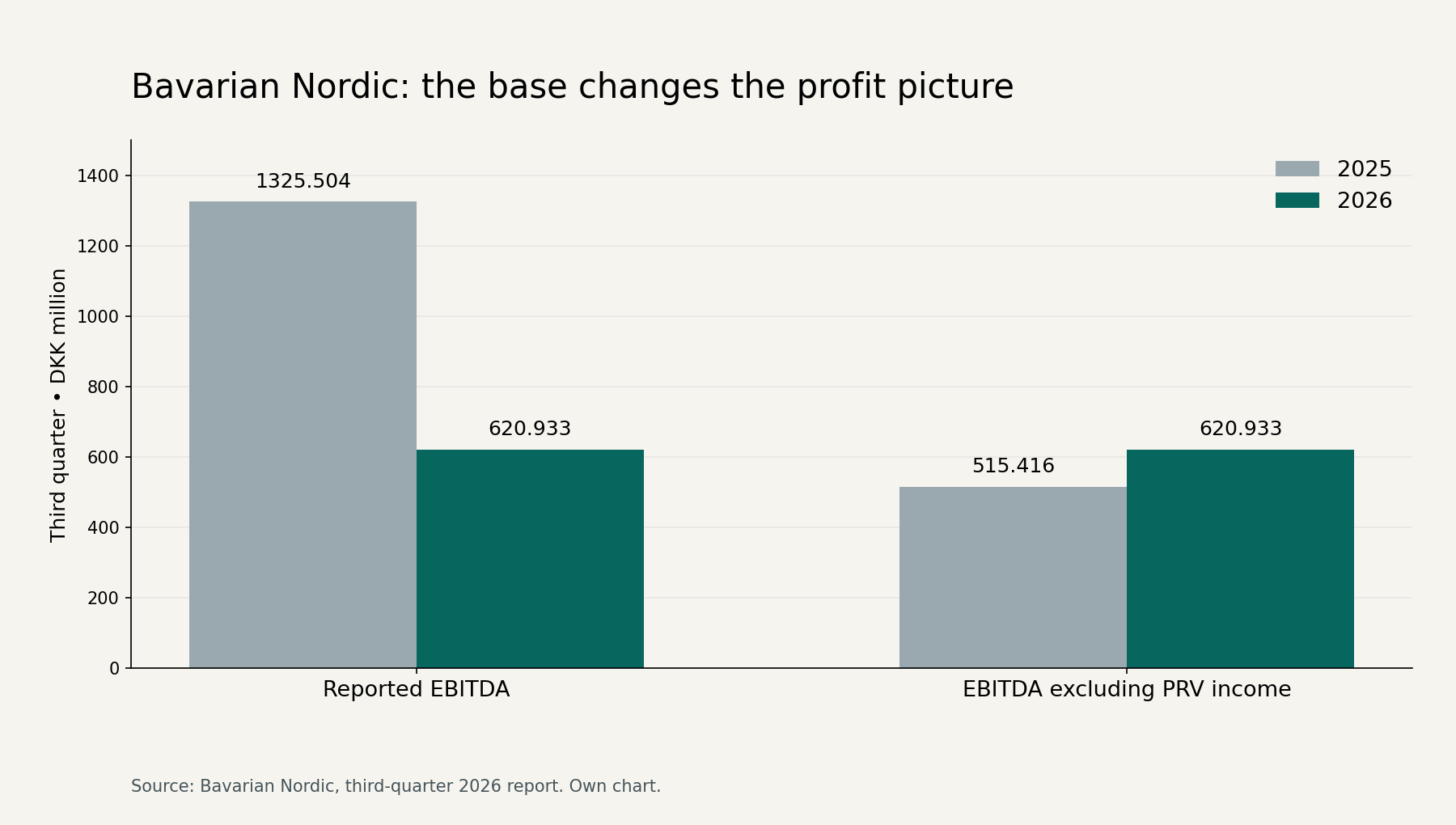
Our chart uses the linked report and a zero-based axis. The bars compare corresponding quarters and keep reported figures separate from those excluding PRV income.
The economic significance is that the earlier period’s one-off income created a high comparison base. This year’s operations can therefore be stronger while total reported earnings are lower. The choice of adjustment must always be justified, otherwise selecting the more favourable measure can become cherry-picking.
EBITDA is not cash available for distribution to shareholders. Interest, tax, investment and working capital movements can separately affect available funds. For a pharmaceutical company, inventory building, contractual deliveries and development timing are also relevant considerations, alongside the earnings margin.
Customer composition is a risk to assess separately. For government orders, procurement, budget decisions and acceptance dates may follow a different rhythm from consumer travel demand. One strong quarter therefore need not describe the entire business cycle. Investors should also look for contractual visibility and the usability of inventories in subsequent reports.
When examining cash generation, it matters whether the customer has already paid or revenue remains a receivable. Growing inventories may prepare future sales but also tie up cash and can cause losses if demand changes. Development spending can similarly burden cash in the short term while laying the foundation for future products. These are general analytical considerations, not verified new company problems. The buyback decision should be assessed against these capital needs and liquidity reserves, rather than solely on the announcement.
Our earlier Allianz earnings analysis similarly separated different profit measures. Our article on Siemens Energy’s annual performance compared targets with actual figures in a different business model. These are methodological links, not an industry ranking.
The quarter implied by the annual target
The company’s annual revenue target in DKK million is 6100, with an EBITDA margin target of approximately 32 percent. Rounded revenue for the first nine months was 4897 and EBITDA was 1711. Our derivation uses these published rounded figures, rather than every decimal in the detailed table.
The difference between the annual target and revenue already delivered is 1203. Multiplying the annual revenue target by the targeted margin gives 1952; deducting earnings already delivered leaves 241. Dividing the latter difference by the former implies a fourth-quarter margin of 20.03 percent. The reported third-quarter margin was 34.4 percent.
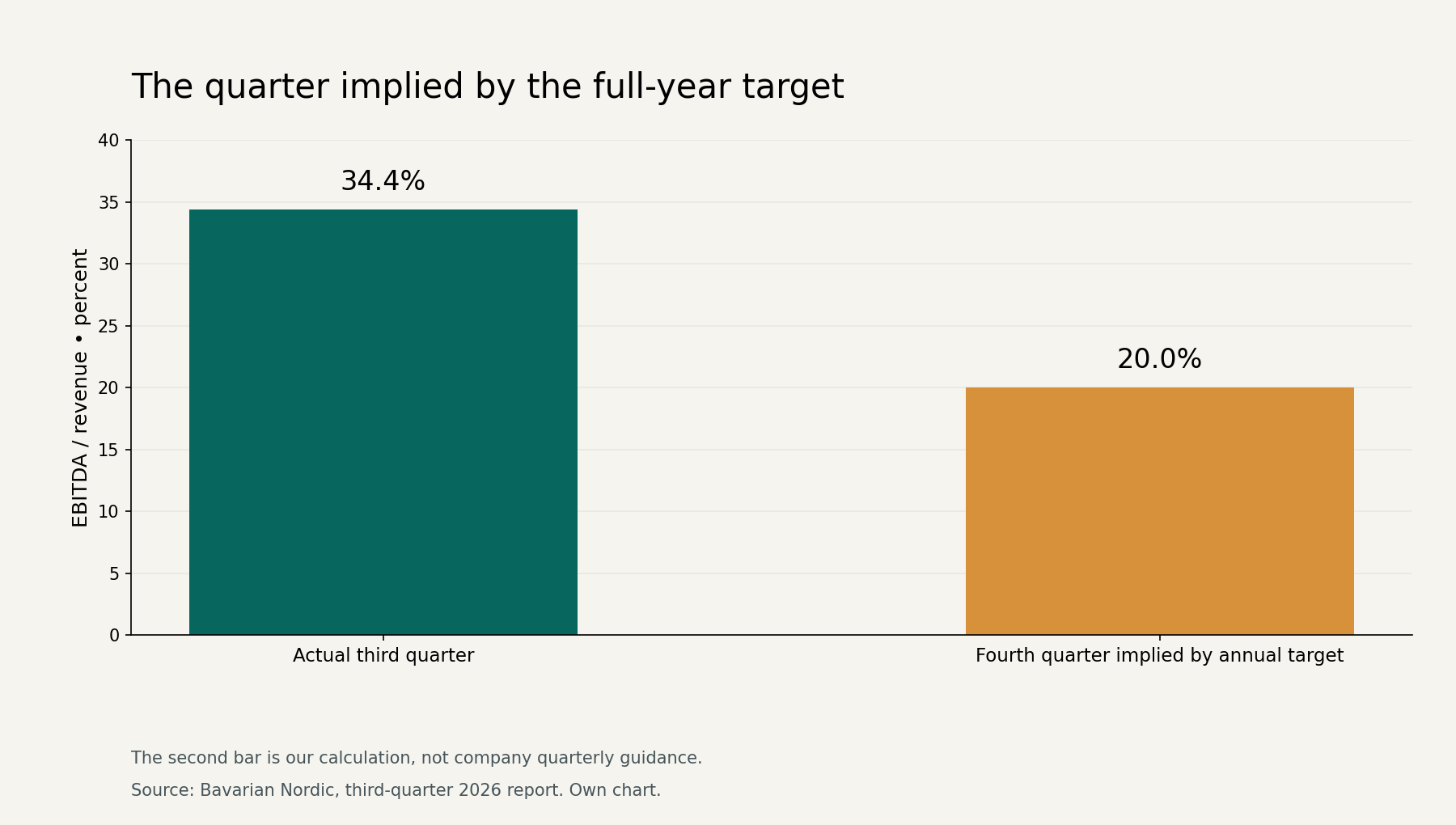
Our chart rounds the calculated bar to one decimal place. This is an arithmetic implication, not separate company quarterly guidance. Because the annual target is approximate, the derivation is not a precise commitment either.
Our interpretation is that the latest quarter’s higher margin should therefore not be projected forward unchanged. Product mix and delivery timing can alter the next period. In a favourable scenario, a better mix could help; in an adverse one, delayed orders or additional costs could reduce room for manoeuvre.
These are conditional scenarios, not new forecasts from management. The analysis benefits from a transparent link between the annual target and performance to date; its limitation is that it does not forecast earnings timing in detail.
A separate buyback announcement set out a new tranche of up to DKK 250 million, starting on November 13 and ending no later than January 15, 2027. It promises weekly reports of actual transactions. That is a verifiable next sequence of events, but the maximum allocation does not imply guaranteed share-price gains.
Hungarian investors’ own account
In our illustrative example, the share rises by 10 percent in Danish kroner while the krone’s HUF value falls by 5 percent. The two factors are 1.10 and 0.95. Subtracting one from their product yields a gross HUF return of 4.5 percent. Currency effects are therefore calculated through multiplication, rather than simple subtraction.
If we assume a further 1 percent total cost deducted from the final converted value, the third factor is 0.99. The result is 3.455 percent, rounded to 3.46 percent. We explicitly define the cost base as the final value; a different fee structure may produce a different result.
This example is not an observed share return or a current exchange rate. It also excludes tax, dividends and hedging. An actual comparison requires the investor’s own purchase and sale prices, account statement, currency conversion terms and provider fee schedule.
Without a verified current share price, we provide neither a valuation multiple nor a price target. Strong operating performance and an attractive purchase price require separate examination. The conclusion about company performance thus does not become personalised advice to buy or sell.
The next weekly buyback update will allow actual spending and share numbers to be compared with the announced allocation. At the annual results, target delivery, one-off items and cash generation should be assessed using consistent definitions. That will make it possible to track how durable the current improvement proves.
Original editorial content. Read our editorial standards.
Budapest Global Review: Bavarian Nordic: last year’s one-off income distorts profit. Budapest Global Review, 13 November 2026. https://globalreview.hu/en/cikk/bavarian-nordic-profit-bazis-forint-2026