
In brief
- Berkshire's total earnings fell faster than operating earnings.
- Our breakdown attributes most of the decline arithmetically to the change in investment earnings.
- The USD and costs also shape a Hungarian investor's result in forints.
The two earnings measures answer different questions
Berkshire Hathaway's third-quarter figures, released on November 7, create a particular reading task for Hungarian savers holding foreign shares: changes in company earnings and the return on their own investment require separate calculations. This analysis breaks down the earnings structure; it makes no claim about a share-price reaction or expected stock return.
According to the company's earnings release, net earnings in the third quarter of 2026 were USD 22112 million, compared with USD 30796 million in the same period of 2025. Operating earnings were USD 12705 million and USD 13485 million respectively, while investment gains were USD 9407 million and USD 17311 million. These are after-tax, group-level figures.
The company also asks interested readers to consult the detailed filing: “read our 10-Q”. The short release is therefore a starting point. It supplies no standalone valuation, and the breakdown presented here does not replace a combined examination of the balance sheet, cash flows and risk disclosures.
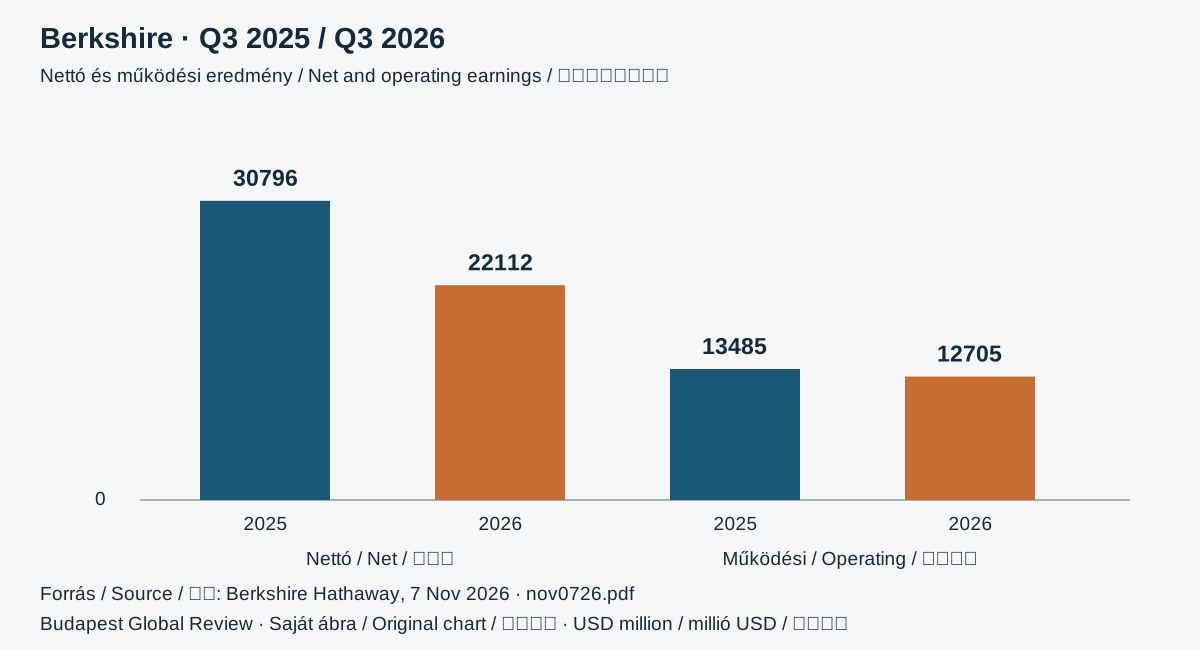
Our calculation puts the annual change in net earnings at minus 28.20%, and the change in operating earnings at minus 5.78%. In each case, the formula divides the current figure by the previous year's figure, subtracts one and multiplies by one hundred. We round to two decimal places without further rounding the underlying figures.
Our editorial reading of the difference is that the fall in total earnings should not be attributed in the same proportion to every operating business. Group earnings aggregate several different economic processes. An accounting total can be accurate while remaining difficult to interpret in a short-term comparison.
Operating earnings are a company-defined non-GAAP measure excluding investment gains. Net earnings can also include unrealised changes in the value of equity investments. Accordingly, operating earnings should not be described as cash generation either: they are a different concept whose reconciliation and content matter.
Breaking down the decline
The change in net earnings is minus USD 8684 million. Of this, the change in operating earnings is minus USD 780 million and the change in investment gains is minus USD 7904 million. Adding the two differences reproduces the overall change. The second chart shows this verifiable relationship using a common unit and period.
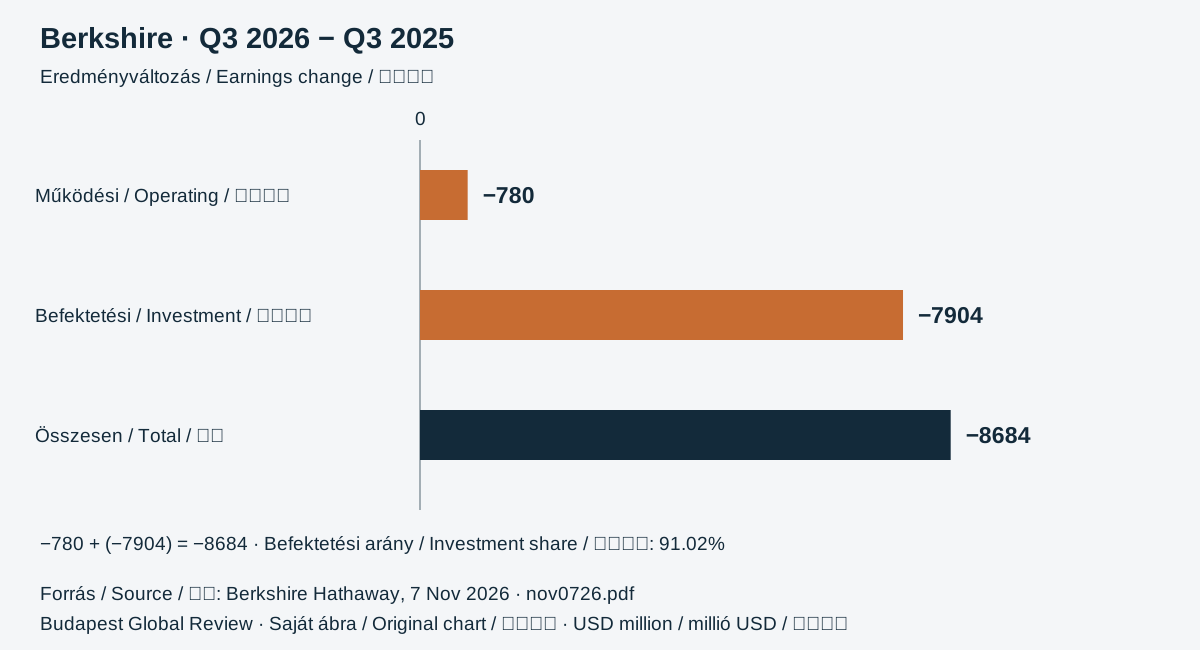
The change in the investment line therefore accounts arithmetically for 91.02% of the total decline. This is a decomposition share, not a proven economic cause or an equity portfolio's return. The calculation divides 7904 by 8684 and multiplies by one hundred, using the absolute values of the negative differences.
The method's advantage is that anyone can reproduce the same earnings bridge from the release. Its limitation is that it does not reveal every underlying investment position, the cash requirements of individual businesses or future performance. Those questions require other data, so we derive no target price from the charts.
Our analysis of MOL's one-off items is relevant to this interpretation: separating reported earnings from individual contributions was important there too. The ArcelorMittal earnings-margin analysis provides another example of why an earnings measure's precise meaning must be identified.
The three companies have different business models, so these are not direct valuation comparisons. The shared lesson concerns method: first identify the earnings line being read, then compare figures for the same period and in the same units. Only then does a percentage change acquire economic meaning.
The earlier year consistently provides the same comparison base throughout the charts. The first chart's bars start at zero, avoiding distortion from a truncated axis. The second shows contributions to a decline; the total decline must not be added again to its two components. The underlying figures expressed in millions are not earnings per share and therefore cannot be divided directly by a share price. A valuation measure would also require the appropriate share count and earnings for a comparable period. Without those, the present ratio describes only the annual change in aggregate earnings, not whether the stock is cheap or expensive.
Forints, costs and scenarios
The Hungarian retail investor's second calculation concerns their own position. The stock return measured in USD and the change in the USD's forint exchange rate jointly determine the gross return expressed in forints. The relationship is multiplicative: multiply the two return factors and subtract one from the result.
In a purely illustrative scenario, if the stock's USD value remains unchanged, a weakening forint increases its forint value, while a strengthening forint reduces it. If the share and the currency move in opposite directions, they can partly offset each other. This is a conditional relationship, not an exchange-rate forecast.
The Investor.gov guide to international investing also addresses the significance of currencies and costs. A Hungarian customer's actual settlement nevertheless depends on their own provider's terms. The currency-conversion spread, trading commission and any account charges can reduce the gross result.
Costs should be aggregated in the same settlement currency and for the same holding period. A one-off charge and a recurring charge affect short and long investments differently. The company's earnings release supplies no information about these customer-level costs.
Risks to examine separately include the durability of business earnings, fluctuations in investment values and the concentration of the investor's own portfolio. Even shares in a diversified company are an asset tied to a single issuer. This one company filing does not tell us how an investor's total wealth is allocated.
A favourable conditional path could involve operations stabilising and investment values supporting overall earnings. Under an adverse path, both could weaken while forint movements cause additional losses in the Hungarian investor's accounting currency. These are not probability estimates; they illustrate why simultaneous changes in several factors matter.
The next company information to examine is the reconciliation of items in the detailed quarterly filing and a subsequent confirmed earnings release. We specify no new publication date without a verified company calendar. Nor do we claim that a stock-market reaction to the Saturday release has already been observed.
What readers can reproduce now is the numerical breakdown of the earnings change. A considered assessment must add their own currency exposure, costs, time horizon and tolerance for losses. This analysis is general information and offers no personalised recommendation to buy or sell.
Original editorial content. Read our editorial standards.
Budapest Global Review: Berkshire's investment earnings drove the profit decline. Budapest Global Review, 7 November 2026. https://globalreview.hu/en/cikk/berkshire-eredmeny-befektetesi-hatas-2026