
Pfizer raised its annual guidance on 3 November, while third-quarter revenue was broadly flat. The company’s earnings release shows that reported net income and adjusted income moved in different directions. That difference poses a more important interpretive task than the release’s upbeat tone.
For Hungarian retail investors, there are two separate questions: how much profit the company generates, and how an investment held in USD performs in forints. The calculations below provide comparable income margins for the former and hypothetical currency paths for the latter. They do not establish a share price, price target or personalized purchase recommendation.
In brief
- With revenue stable, reported and adjusted profit require separate examination.
- Our calculation compares income relative to revenue in corresponding quarters.
- Currency movements, costs and taxation also shape Hungarian investors’ final results.
Two income measures, different conclusions
The input data are expressed in millions of USD. Third-quarter revenue was 16583 in 2026 and 16654 in the corresponding period a year earlier. Reported net income, in the same order, was 3242 and 3541, while adjusted income was 4985 and 4949. The company expects full-year revenue of USD 62 billion to 64 billion. This is management guidance, not a completed annual result.
CEO Albert Bourla described the quarter in the release using the phrase “commercial momentum and disciplined execution”. That is management’s assessment. Investment analysis must distinguish it from comparing the numerical series, because different levels of the income statement may diverge even alongside a positive business narrative.
Our methodology is simple: divide the relevant income by revenue for the same quarter, then convert it into a percentage. The reported income margin is therefore 19.55%, compared with 21.26% previously; the adjusted margin is 30.06% and 29.72%, respectively. The calculation uses the published, rounded figures in millions, with results rounded to two decimal places. The chart’s vertical axis starts at zero.
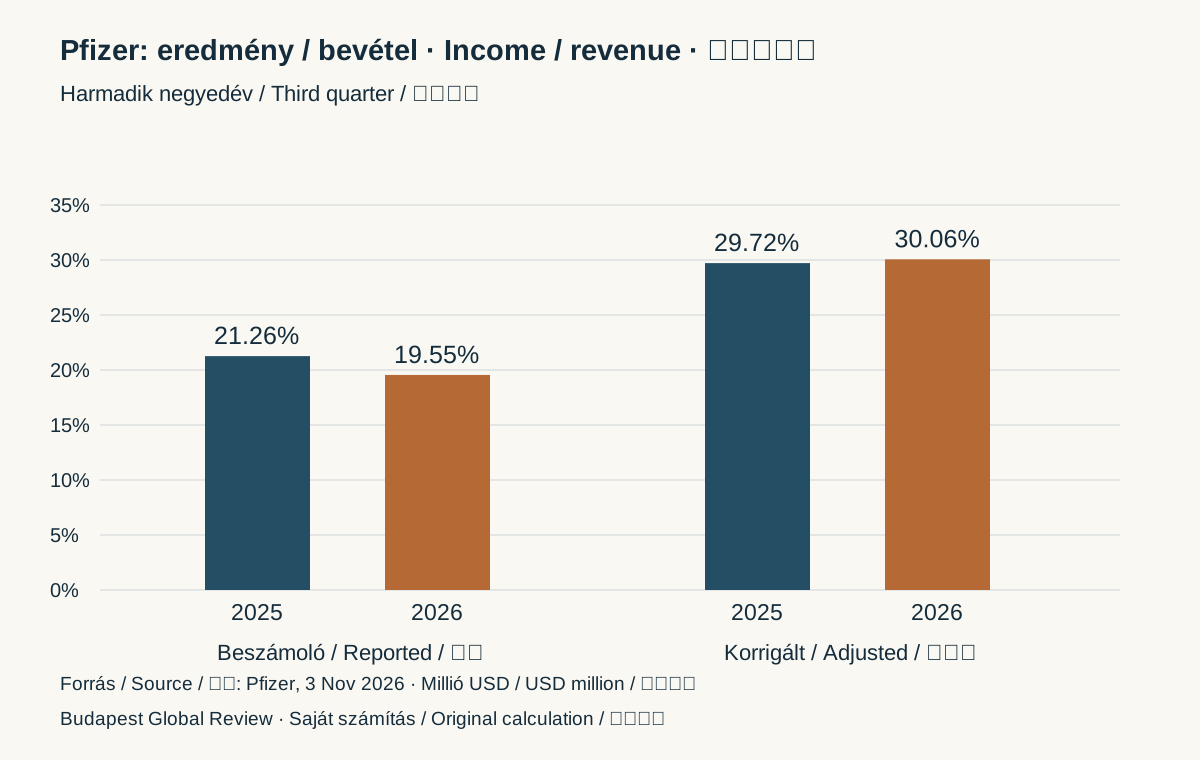
The first chart uses the linked company table as its source; calculations and presentation are by Budapest Global Review. The adjusted series is a measure defined by the company. Comparing the two margins illustrates the importance of accounting differences; it does not establish that excluded items are economically irrelevant. The method uses the same revenue denominator, so the origin of the difference must be sought on the income side.
One limitation is that the net income margin compresses several cost and tax effects into a single number. It is neither an operating margin nor a measure of cash generation. The next analytical step is to reconcile adjustments with reported accounts and examine which items could recur. A better-founded view of the persistence of an expense described as exceptional requires data over several periods.
Investment performance can differ in forints
The US regulator’s investor guidance discusses exchange-rate changes and costs among the special risks of international investing. In the Hungarian application, the starting currency is the forint. A USD-denominated equity return therefore needs to be converted together with the currency movement over the same holding period; changes in the company’s earnings are a separate measure.
In our illustrative scenario, the investment return measured in USD is 10% in every case. If the USD/HUF rate falls by 5%, remains unchanged or rises by 5%, the gross return in forints is 4.5%, 10% and 15.5%, respectively. These are assumed inputs, not exchange-rate forecasts. The second chart shows only this mechanical relationship, not Pfizer’s expected performance.
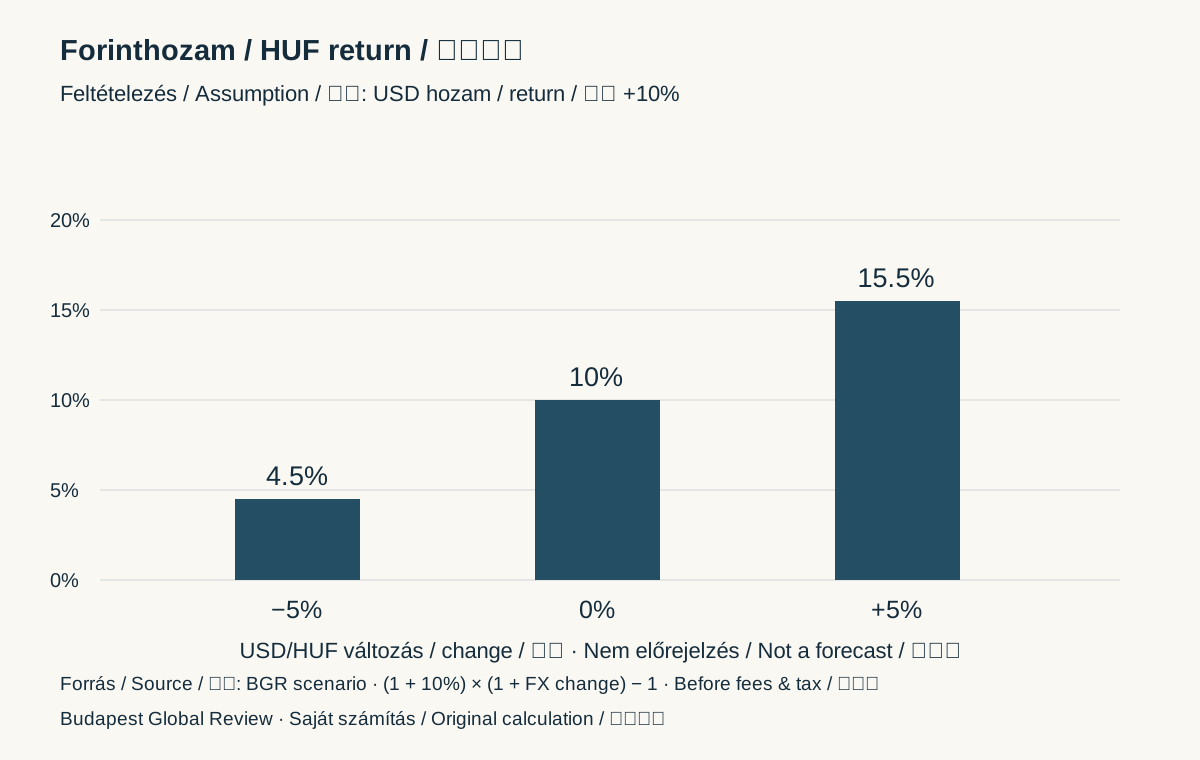
In words, the formula multiplies the USD-return factor by the currency-change factor, then subtracts one. It assumes identical start and end dates, an unchanged number of shares and unhedged currency exposure. The example includes no dividend, tax, trading commission or conversion cost. An actual investment requires these to be included separately in cash flows.
Simply adding the percentages would produce an inaccurate result because the currency effect applies to the changed USD value. A loss-making share-price path can be calculated on the same principle, but our example assigns no probability to either direction. The useful lesson is to separate exposures: company earnings, stock-market valuation and currency are three distinct components.
When comparing costs, the gap between buying and selling prices, conversion terms and any account fee matter alongside the dealing fee. The same fee amount can represent a larger proportion of a smaller investment. Taxation can also depend on account type and individual circumstances, so this example assumes no net return applicable to every reader.
What should the next disclosure clarify?
Our analyses of Marriott’s earnings and currency risk and SK hynix’s income margins illustrate similar methodological distinctions. Comparability requires choosing the same income level and period for each company. A simple margin ranking across industries cannot replace examining their business models.
In a favorable scenario, improving operations would also show up persistently in reported income. In an unfavorable scenario, adjustments, development costs or other charges would leave the two income levels far apart. These are analytical possibilities, not events that have occurred. Subsequent financial tables and detailed reconciliations will provide the evidence.
The next verified event is Pfizer’s 3 November earnings webcast. Substantive questions concern how management explains the gap between reported and adjusted income and the assumptions behind annual guidance. The event announcement is verified; answers not yet delivered are not treated as facts.
The two charts answer different questions: the first calculates ratios from observed company data; the second calculates consequences of assumed market changes. The method does not establish a causal link between them. A higher income margin can coexist with an unfavorable investment return if the purchase price reflected excessive expectations or the currency moved adversely. The sequence of analysis therefore matters: first examine the substance of company performance, then the price paid for it, and finally the result in the investor’s own currency, assessing each separately every time. This release supplies new evidence for the first question; the other two require additional information for the appropriate dates.
The calculation provides a decision framework, without replacing a review of the complete company accounts and investment terms. A share-price reaction alone does not establish the quality of the quarter, and a company release does not establish market consensus. The conclusions stop where the published data end.
Original editorial content. Read our editorial standards.
Budapest Global Review: Pfizer: diverging income margins and a separate currency risk. Budapest Global Review, 3 November 2026. https://globalreview.hu/en/cikk/pfizer-eredmenyarany-devizakockazat-2026