
ArcelorMittal's results release on 5 November showed improving operating profitability alongside a net loss for the third quarter. For Hungarian retail investors, the choice of earnings measure and costs calculated in forints both matter; Hungarian companies buying steel may experience the same pricing environment from the other side.
In the company's statement, Chief Executive Aditya Mittal said: “We continue to generate healthy margins”. This is management's assessment. Reuters' report also highlighted exceptional costs associated with the Ukrainian plant's idling. Our analysis calculates reproducible ratios from published figures and uses neither a share price nor analyst consensus.
In brief
- The operating earnings measure and the bottom line attributable to shareholders give different pictures.
- Adjusted profit needs to be read alongside the explanation of excluded items.
- Currency movements and actual fees also shape investment returns in forints.
One revenue base, different earnings measures
The group's third-quarter revenue was USD 16466 million and EBITDA was USD 2023 million. Reported net income attributable to shareholders was minus USD 391 million; the adjusted equivalent was USD 868 million. The release provides unaudited, rounded figures; the period ended on 30 September.
Our method divides each earnings measure by the same revenue and multiplies by one hundred. The resulting EBITDA margin is 12.29%, the adjusted net margin 5.27%, and the reported net margin minus 2.37%. The arithmetic difference between the two net income measures is USD 1259 million. That difference cannot all be described as cash spending during the quarter: accounting recognition and the timing of cash movements are separate questions.
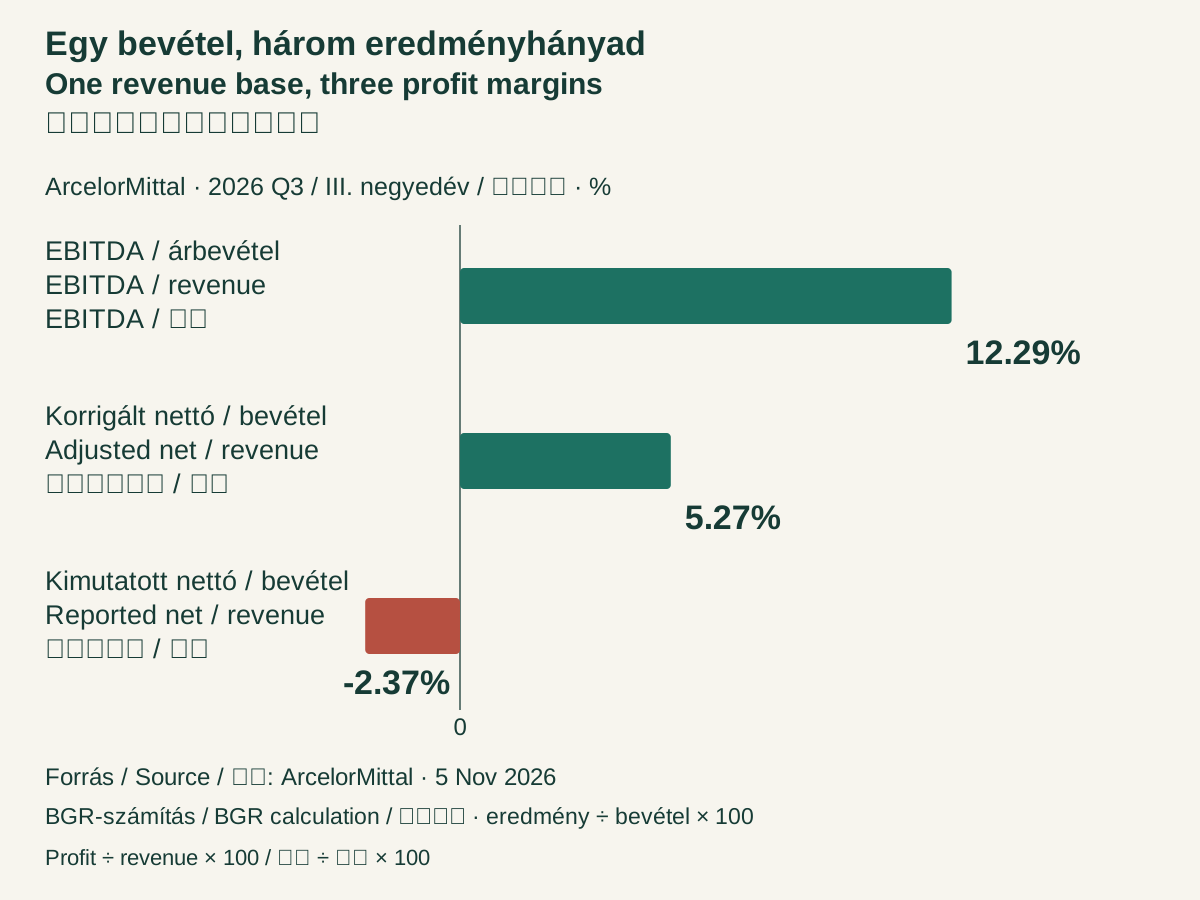
The chart uses a common denominator to reveal the difference. EBITDA focuses on performance before interest, taxes, depreciation and amortisation; several further accounting items lead to shareholder earnings. The distance between the measures is therefore more than a difference in names. In a capital-intensive plant, money needed to replace machinery remains an economic burden even though the EBITDA calculation does not deduct depreciation.
An adjusted measure can help compare recurring operations, but the content of exclusions needs separate assessment. An investor who singles out only the more favourable earnings measure may lose the connection to the actual shareholder result. The opposite mistake is also possible: one loss-making quarter does not establish persistently weak performance throughout the business. Meaningful comparison requires following the same definition across periods.
Annual growth and the comparison base
In the same quarter of the previous year, revenue was USD 15657 million, EBITDA USD 1508 million and adjusted net income USD 474 million. Our calculations put annual growth at 5.17%, 34.15% and 83.12%, respectively. The formula divides the new value by the old value, subtracts one and multiplies by one hundred. Every result is rounded to two decimal places.
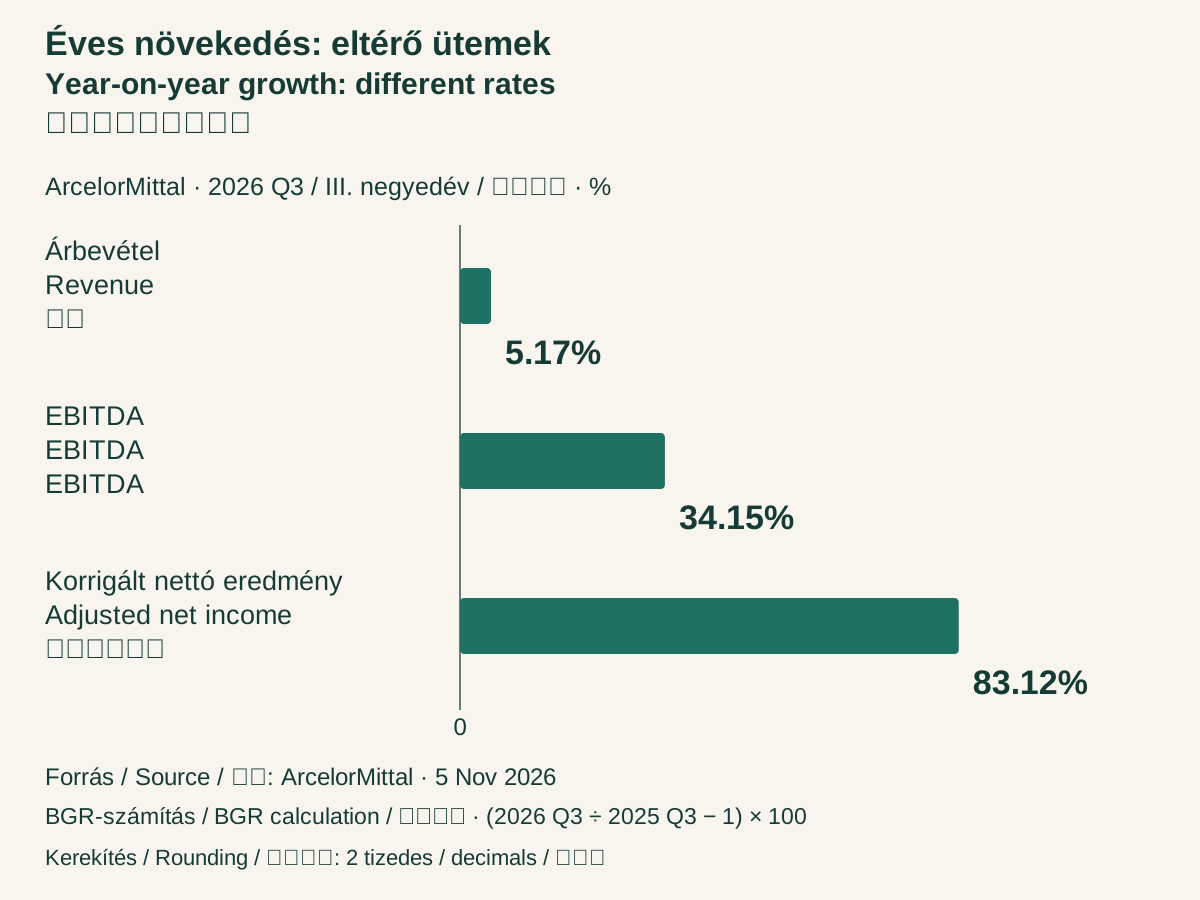
The second chart compares growth in measures with different starting bases. Faster profit growth does not translate into an equivalent share return, and revenue growth does not separately identify volume or pricing effects. Product-mix, sales and cost information is needed for that. The percentages use rounded figures from the release, so they may differ slightly from company ratios calculated using fully precise underlying data.
For Hungarian industrial readers, their position in the value chain is particularly important. A better selling price for a steelmaker can mean a higher purchasing cost for a processor. The ability to pass that on depends on contracts, inventories and customer demand. The Hungarian manufacturing survey provides domestic demand context, but does not measure direct exposure to ArcelorMittal.
A conditional favourable scenario combines better selling conditions with sustained orders while costs rise more slowly. In an adverse case, energy, transport or another production disruption could erode part of the improvement. These are analytical possibilities, not events that have occurred or quantified probability forecasts. Better industry pricing does not eliminate wartime operational risk.
The forint and the next questions
The MNB's official exchange rate for 5 November is HUF 363.12 per EUR. An illustrative EUR 1000 transaction therefore has a reference value of HUF 363120. The multiplication is reproducible, but this is not a bank's exchange offer: the provider's spread, commission and any minimum fee are separate items. Their amount is unknown in this example, so we do not claim a complete transaction cost.
A share's quotation currency and the company's reporting currency are distinct concepts. The group's earnings reported in US dollars do not determine the currency in which an investor's order settles. This must be checked against the selected market and instrument. Our earlier currency-risk analysis illustrates the calculations behind the same forint-based perspective.
The US investor-education guidance also distinguishes exchange-rate effects from other risks of foreign investment. Our conclusion is that, alongside local share performance, returns should also be tracked in the investor's own accounting currency. Forint appreciation can reduce the domestic-currency value of a foreign asset, while depreciation can work in the opposite direction; fees matter in both cases.
Our analysis of BMW's results provides another example of separating profit from cash flow. Here too, the open question is how far an improving operating measure translates into financeable investment and actual cash generation. Adjusted profit does not justify inferring a direct dividend promise or certain stock-market appreciation.
Valuation conclusions require not just business earnings but also the share price, share count, debt and cash. These support different measures emphasising different risks. The margins calculated here are therefore operating comparisons. They do not establish whether the market price is cheap or expensive, and a single quarter does not demonstrate a lasting growth path. Consistent comparison of subsequent reports can provide further evidence.
The next verified event is the investor presentation scheduled for 5 November at 16:00 Budapest time. Watch how management explains the difference between adjusted and reported earnings, and the conditions it sets for sustained improvement. New answers should be compared with the original report. This is general market analysis without a personalised recommendation to buy or sell.
Sources and method: the linked company earnings table, Reuters, MNB and Investor.gov; our own ratio calculations and charts. The photograph is archival, and the data charts process the published quarterly values.
Original editorial content. Read our editorial standards.
Budapest Global Review: ArcelorMittal: stronger margins alongside a net loss. Budapest Global Review, 5 November 2026. https://globalreview.hu/en/cikk/arcelormittal-eredmenyhanyad-veszteseg-2026