
MOL's results release on 6 November reported a sharply rising third-quarter operating earnings measure, also supported by one-off items. For Hungarian retail investors, the important question is therefore how much represents comparable performance and what may subsequently turn into cash generation.
In the company statement, Chairman and Chief Executive Zsolt Hernádi said: “We had a particularly good quarter.” This is management's assessment. The public summary from K&H Securities also highlighted the one-off items; this is external market commentary, not an independent audit. The ratios below are our own calculations; we use neither a share price nor analyst consensus.
In brief
- The operating measure strengthened both year on year and quarter on quarter.
- Deducting one-off items is an illustrative calculation, not a new company earnings category.
- Forint exposure and investors' fees separately influence returns.
Growth against two different bases
According to the quarterly presentation, group Clean CCS EBITDA was USD 1760 million. The comparable figure for the preceding quarter was USD 1297 million, and for the same period a year earlier USD 974 million. The published, rounded values imply growth of 80.70% year on year and 35.70% quarter on quarter.
In both cases, the formula divides the new value by the selected base, subtracts one and multiplies by one hundred. We rounded to two decimal places. The first chart labels the periods separately: annual change and the difference between consecutive quarters answer different questions and cannot replace each other.
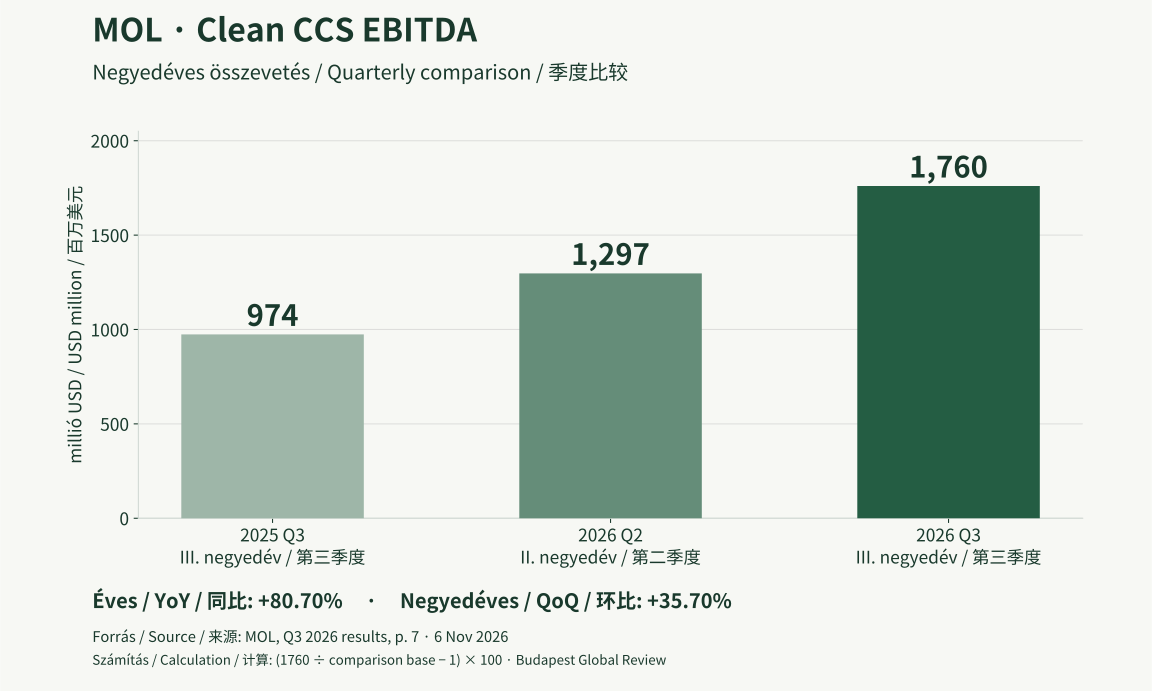
Clean CCS EBITDA is the company's operating measure adjusted for inventory price effects and specified special items. However, the word “clean” does not establish that every one-off economic effect has disappeared from it. Investors always need to read the definition alongside the explanatory items for the particular quarter.
The press release reports profit before tax of USD 1250 million. This is a different earnings line: the gap between EBITDA and pre-tax profit cannot be explained simply by deducting the one-off items. Financing and depreciation accounting also matter; neither measure directly reveals shareholder returns.
One-off support and movements of cash
The presentation highlights a USD 100 million insurance payment and USD 133 million of income associated with financial assets transferred from a foundation. Together they amount to USD 233 million. Our ratio divides that amount by the operating measure and multiplies by one hundred, giving 13.24%.
The second chart splits the total measure between that amount and the arithmetic remainder. The remainder is USD 1527 million, or 1760 minus 100 minus 133. This is solely an editorial illustration. It is not an official adjusted result or a forecast, and does not establish that every other component is recurring or sustainable at an unchanged level.
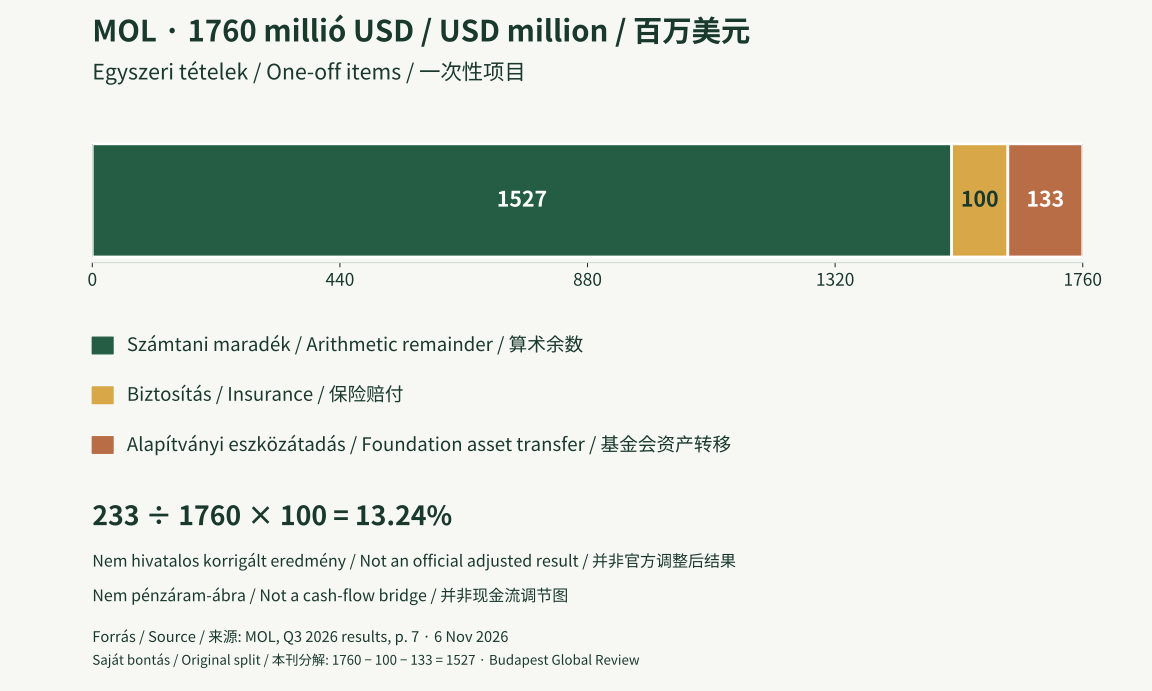
Insurance compensation and accounting for the transfer of financial assets may involve different cash movements. In connection with the foundation transaction, the report also identifies USD 62 million in withheld cash that was not recognised as cash flow. It would therefore be wrong to treat the reported earnings support entirely as cash received.
Changes in receivables, inventories and trade payables also matter when examining cash generation. A sale may improve earnings while its proceeds arrive later; building inventories can tie up money. These are general accounting relationships, not assertions about any unverified individual transaction in the current quarter.
Our analysis of ArcelorMittal's margins used another company to distinguish operating earnings from shareholder earnings. Our BMW cash-flow comparison examined the relationship between cash generated and investment requirements. The conceptual distinction is shared, but business risks must be assessed company by company.
Forint exposure, costs and outlook
There is no simple conversion rule valid in every situation between corporate earnings reported in US dollars and a Hungarian investor's wealth recorded in forints. Company revenue and costs can arise in multiple currencies, while hedging transactions can alter sensitivity. We therefore do not calculate a certain profit change from movement in a single currency.
An illustrative, conditional example: USD 1 million is worth HUF 300 million at an exchange rate of HUF 300, and HUF 330 million at HUF 330. The difference is HUF 30 million. These are chosen calculation assumptions, not current quotes, bank offers or estimates of the company's currency sensitivity. Simple translation leaves the underlying business performance unchanged.
The Investor.gov guidance also treats currency movements as a separate risk. Hungarian investors' own cost records should list purchase and sale commissions, account charges and any currency-conversion fee separately. A minimum fee can represent a greater proportion of a small transaction; a complete net return cannot be established without the provider's actual fee schedule.
In a favourable scenario, operating performance remains strong after the one-off support ends, and investments assist subsequent cash generation. In an adverse case, narrowing processing margins, production disruptions or regulatory burdens could reduce earnings. These are conditional analytical possibilities, not events that have occurred or quantified probability forecasts.
According to the company, the Danube Refinery's AV3 unit restarted at the end of October. Plant availability and further insurance settlements may be important in subsequent reports. The company expects additional insurance payments in the coming months; their precise amount and arrival date are not verified here, so we do not build a cash plan on them.
When weighing risks, investors must also decide which time horizon they are examining. A quarterly earnings jump and the return on a multiyear investment require different observation periods. In the short term, movements in inventories and receivables may take priority; over a longer horizon, asset maintenance and operating competitiveness can come to the fore. Deducting a one-off gain does not replace this work. Subsequent periods should be tracked using the same measure within consistent accounting frameworks, with every new exclusion explained; otherwise, selecting the more favourable number may conceal the actual change in the company's performance.
A valuation claim requires not just earnings but also the share price, share count, debt and cash. This article does not assert that the stock is cheap or expensive. The comparison provides a method for reading the report; it contains no personalised recommendation to buy or sell.
Sources and method: company presentation and statement, external market commentary, and our own division and subtraction. Both data charts are original editorial work; the header photograph is archival. Calculations pair the same measure and period, with rounding only at the end.
Original editorial content. Read our editorial standards.
Budapest Global Review: MOL: one-off items also lifted quarterly earnings. Budapest Global Review, 6 November 2026. https://globalreview.hu/en/cikk/mol-egyszeri-tetelek-eredmeny-2026