
In brief
- Allianz’s quarterly operating profit rose while shareholders’ net income declined.
- Different profit measures answer different investor questions.
- For Hungarian savers, EUR and costs also shape returns measured in forints.
Several measures of profit
Allianz’s detailed results released on 12 November show higher operating profit but lower shareholders’ net income in the third quarter. For Hungarian retail investors holding foreign shares, naming the company’s profit measure precisely is therefore as important as calculating their own return in forints.
The key figures table states amounts in EUR millions. Operating profit: previously 4433, now 4709; shareholders’ net income: previously 2847, now 2784; shareholders’ core net income: previously 2855, now 2889. All three comparisons examine the third quarters of 2026 and 2025.
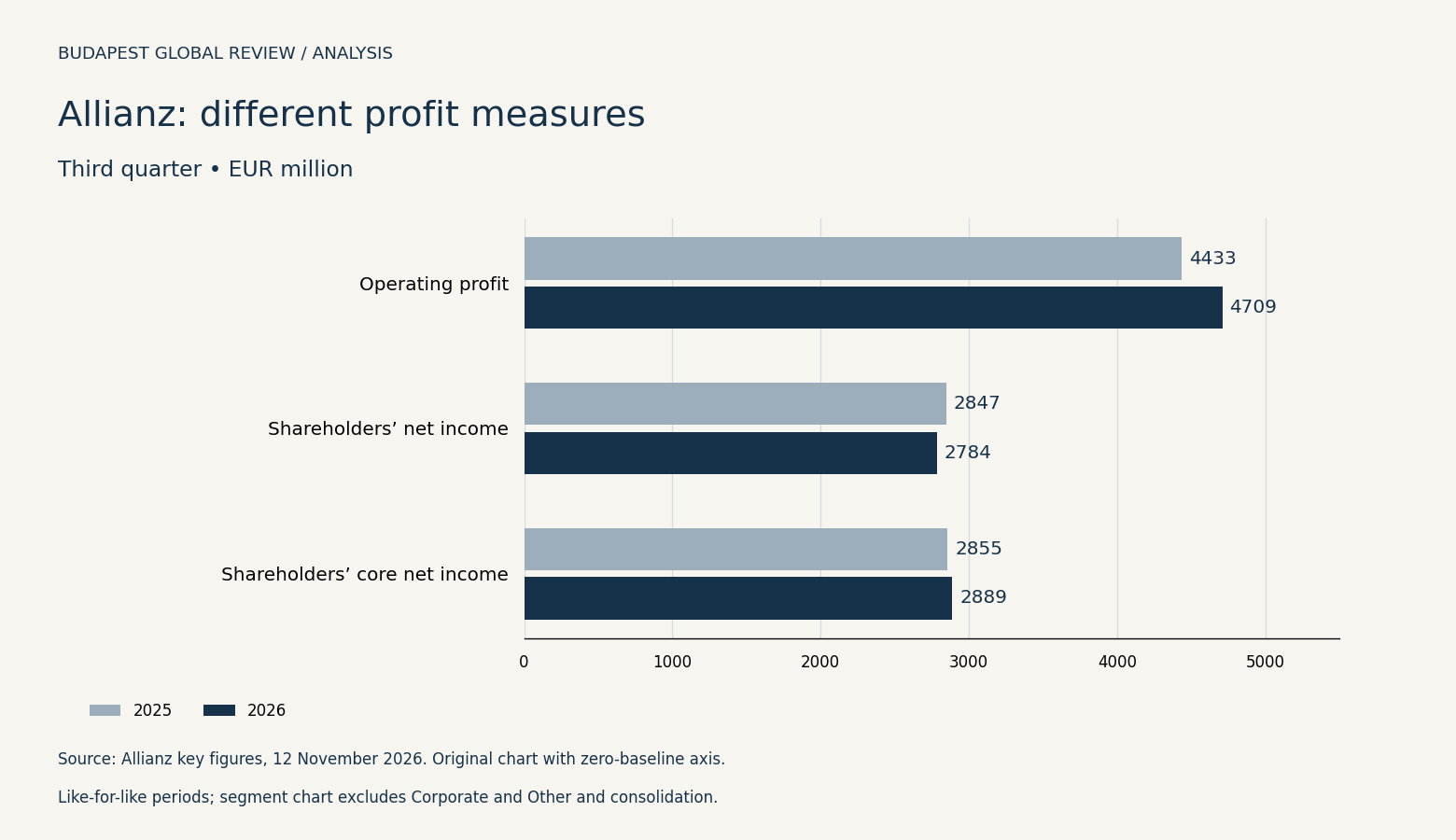
Our calculations put the changes at plus 6.23 percent, minus 2.21 percent and plus 1.19 percent respectively. The reproducible procedure is the same for each row: divide the new value by the earlier value, subtract one, then multiply by one hundred. We round only the final result to two decimal places.
The divergence is not an arithmetic contradiction. Operating profit, shareholders’ net income and the company-defined core measure are separate lines. One lesson of this analysis is to identify the question being answered instead of selecting the most favourable growth rate.
An insurer’s earnings also need to be read alongside cash flows. Revenue recognition, claims payments and investment revaluations may occur at different times. Shareholders’ net income is therefore not immediately distributable cash. Assessing dividends also requires the capital position, the company’s decision and payment conditions. This comparison examines earnings lines, does not calculate a payment due to an individual and does not claim that operating improvement will continue at an unchanged pace in all circumstances.
Segment results are a useful starting point for examining operating performance. Assessing shareholders’ economic interest, however, also requires considering attributable earnings, capital needs and distribution conditions. None of these measures replaces the complete assessment.
Commenting on the nine-month result, Chief Financial Officer Claire-Marie Coste-Lepoutre said “all segments contributing”. The short excerpt comes from the company’s earnings release. This is management’s assessment; the following chart separately examines the figures actually reported for the segments.
Segments and the distance to the target
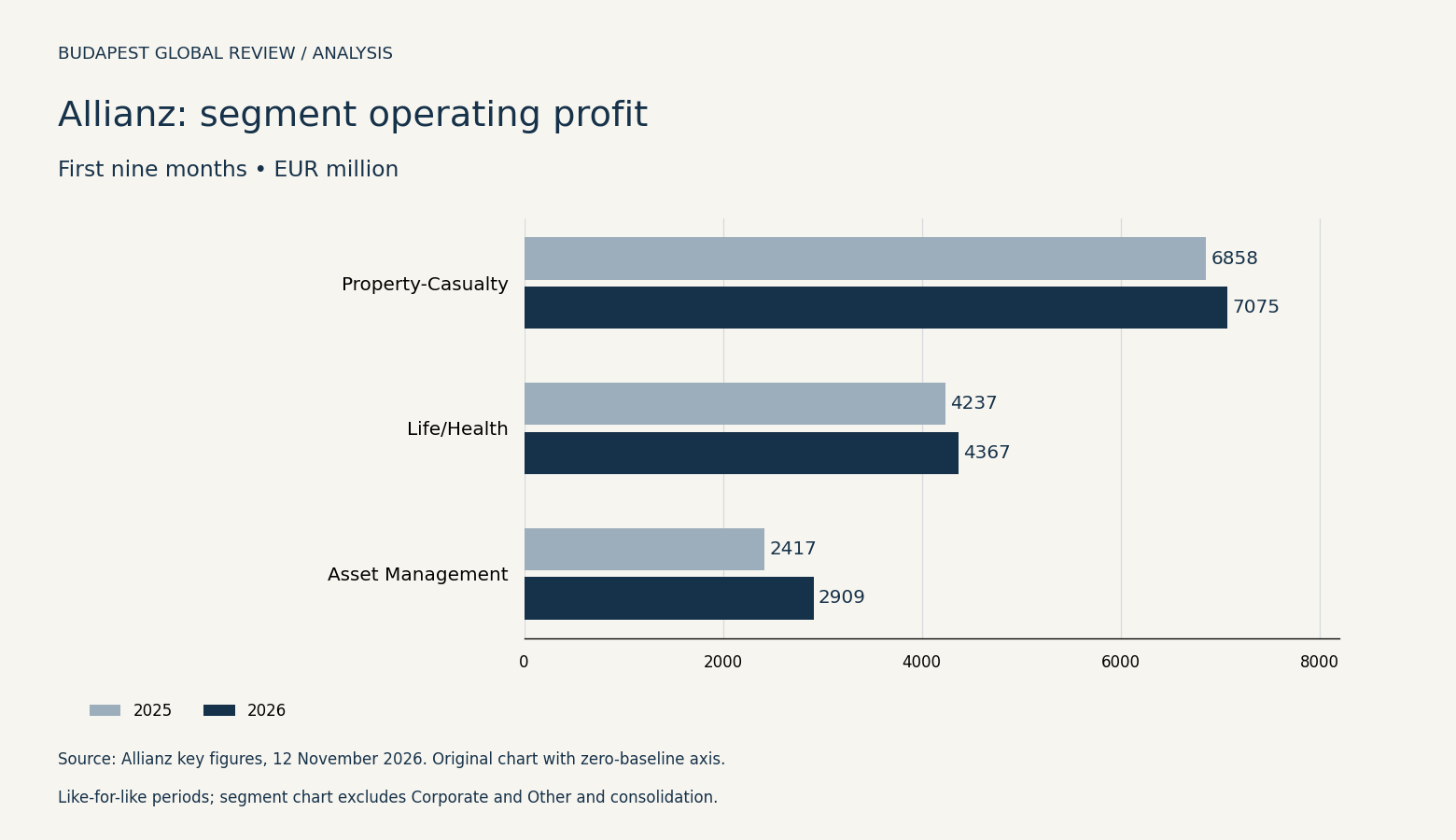
Our second chart shows operating profit for the first nine months and must therefore be distinguished from the quarterly figures in the first chart. The comparison of Property-Casualty, Life/Health and Asset Management relates to the segment breakdown in the analyst presentation. Corporate items and consolidation remain separate.
Calculated from the displayed values, Asset Management growth is 20.36 percent. The corresponding figures for the other two businesses are 3.16 and 3.07 percent. Faster growth nevertheless does not make the businesses equally large: their starting values and absolute profits differ.
The method deliberately uses the published figures rounded to millions. Percentages calculated from them may consequently differ slightly from the company’s percentages based on unrounded data. We therefore label these as our own calculations and do not replace the original corporate percentages with them.
The following amounts are in EUR billions. The upper end of the annual operating profit target is around 18.6, and the reported nine-month result is 14.099. The amount needed in the remaining quarter to reach that upper end is therefore 4.501. This is a conditional requirement obtained by subtraction, not our profit forecast or a company promise.
In a favourable scenario, the businesses maintain earnings generation and cost discipline. In an adverse case, claims burdens, market valuation changes or execution difficulties reduce profit. We assign no probabilities to these possibilities and infer no certain share price from them.
Allianz’s activities have different revenue and risk structures. An asset management result should therefore not be interpreted without adjustment as insurance performance. Analysts need to consider the diversity of the business portfolio alongside shared market exposures.
Our Siemens Energy earnings analysis and interpretation of MOL’s special items use a similar reading method for different business models. These are methodological links, not a ranking of companies in the same industry. Earnings growth can involve different capital requirements and risks.
The Hungarian investor’s own result
A company report does not directly determine the profit appearing in a Hungarian investor’s account. That also requires purchase and sale prices, the holding period, currency conversion and the provider’s actual fees. Without a verified current share price, we give no price target or valuation multiple.
Investor.gov’s international investing guide also separates currency and cost effects. In our illustrative example, the share’s EUR value rises 6 percent, the euro’s forint value falls 4 percent, and a cost of 1 percent is deducted from the final converted value.
The factors are thus 1.06, 0.96 and 0.99. Subtracting one from their product and multiplying by one hundred gives a return in forints of 0.7424 percent. With unchanged currency it would be 4.94 percent; with a 4 percent rise in the euro’s forint value, it would be 9.1376 percent, holding the stock return and cost constant.
These are exclusively assumption-based examples, not observed Allianz returns or current exchange rates. We deliberately apply the cost to the final value; a different fee structure may produce another result. Taxes, dividends and hedging are excluded from the example.
For practical verification, investors can use their own account statements and fee schedules. Charges in different currencies need a common basis, while one-off and time-dependent costs must correspond to the actual holding period. Otherwise, a comparison of gross share returns may mislead.
Separating company performance from personal exposure matters because readers buying the same share at different times, prices and through different providers can achieve different results. A shared earnings release does not make their acquisition conditions identical.
The company calendar schedules full-year results for 24 February 2027. At that point, the current upper target can be compared with the actual annual result, and segment changes can be assessed using consistent definitions. The date is a company schedule and may change.
Both charts use zero-baseline axes and comparable periods. Calculations can be repeated from the linked original tables. Our analysis provides general financial information, not personalised advice to buy or sell.
Original editorial content. Read our editorial standards.
Budapest Global Review: Allianz: operating profit rises, shareholders’ net income falls. Budapest Global Review, 12 November 2026. https://globalreview.hu/en/cikk/allianz-profit-reszvenyesi-eredmeny-forint-2026