
Vislink’s unaudited quarterly results, released on 13 November, show improving operating performance alongside a declining cash balance. This combination matters for Hungarian retail investors because a company’s financial room for manoeuvre can narrow even as its losses shrink. We do not infer a share price or a personalised investment decision from the report.
In brief
- The operating loss narrowed compared with the same quarter of the previous year.
- Cash fell below its level at the previous year-end.
- Currency movements and costs also shape returns measured in forints.
Improving results, different comparisons
According to the company’s earnings release, third-quarter revenue was 4581 thousand US dollars and the operating loss was 782 thousand US dollars. The corresponding figures in the prior-period report were 3824 thousand US dollars and 2306 thousand US dollars. The comparison covers the same quarter in both years.
Our calculation of the revenue change is: (4581 / 3824 − 1) × 100 = 19.8 percent. The absolute operating loss narrowed by 1524 thousand US dollars, or 66.1 percent. The order of calculation matters: we divided the full-precision figures first and rounded only at the end. For a negative result, we compare the size of the loss rather than describe profit growth.
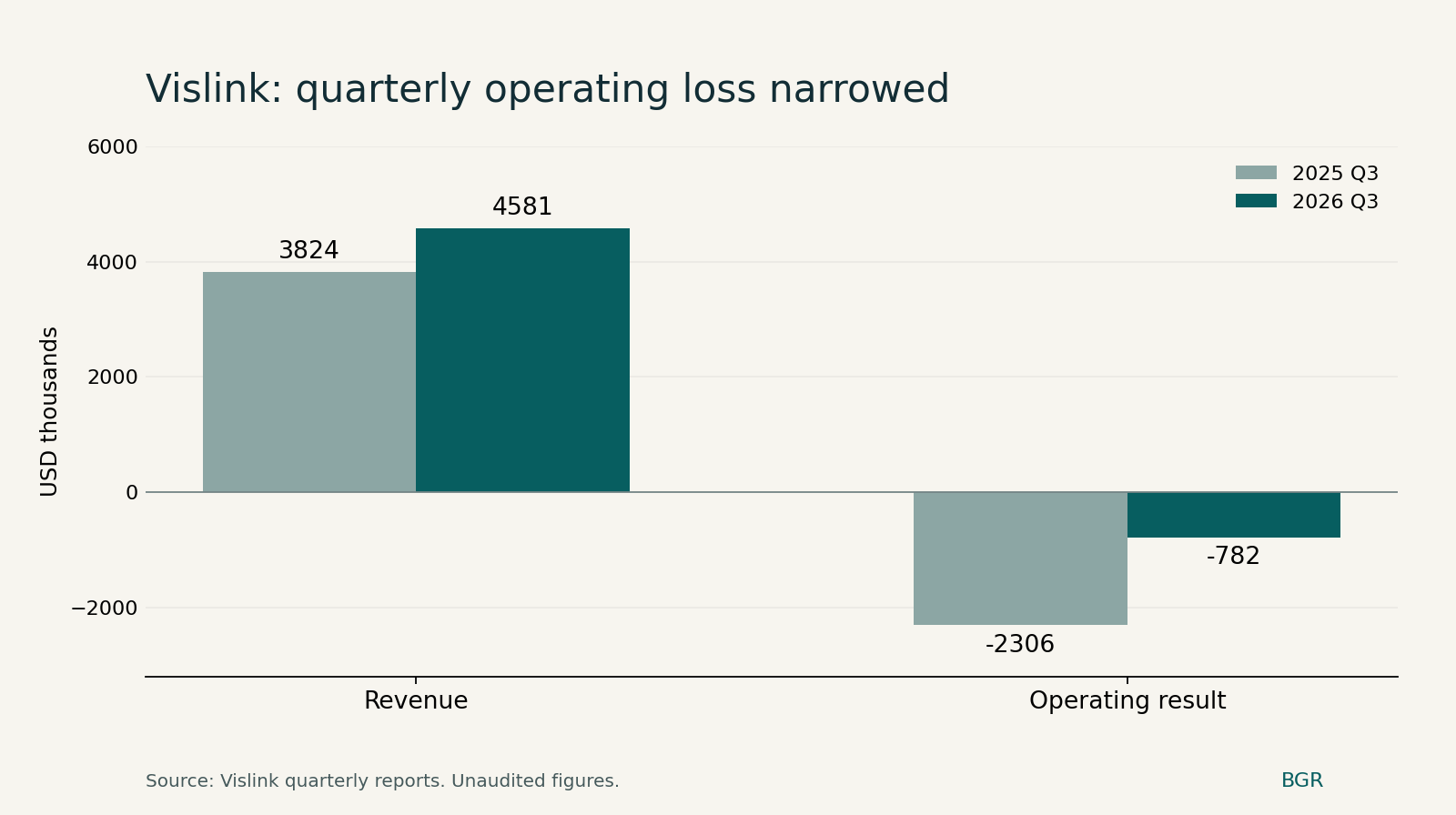
Economically, the improvement means that the loss arising from revenue and operating expenditure became smaller. The result nevertheless remains negative. When assessing the next quarter, the question is therefore whether costs develop favourably alongside sales, and whether the improvement comes from recurring operations.
Our earlier OTP analysis also demonstrated the importance of selecting the comparison base. This is a different company and business model, so the firms’ margins cannot be ranked directly against one another. The same discipline nevertheless applies: use the same period, the same metric and an unambiguous sign.
Cash answers a different question
At the end of September, cash and cash equivalents stood at 1978 thousand US dollars, compared with 4159 thousand US dollars at the previous year-end. Our calculation puts the decline between the balance-sheet dates at 2181 thousand US dollars, or 52.4 percent. This is a change in a balance between two dates, not the third quarter’s standalone cash flow.
Chief executive Mickey Miller said in the release: “We are acting decisively to protect liquidity.” This management statement communicates an intention; the outcome of the measures can be checked against subsequent financial figures. The company’s statement and the editorial calculation therefore represent separate types of evidence.
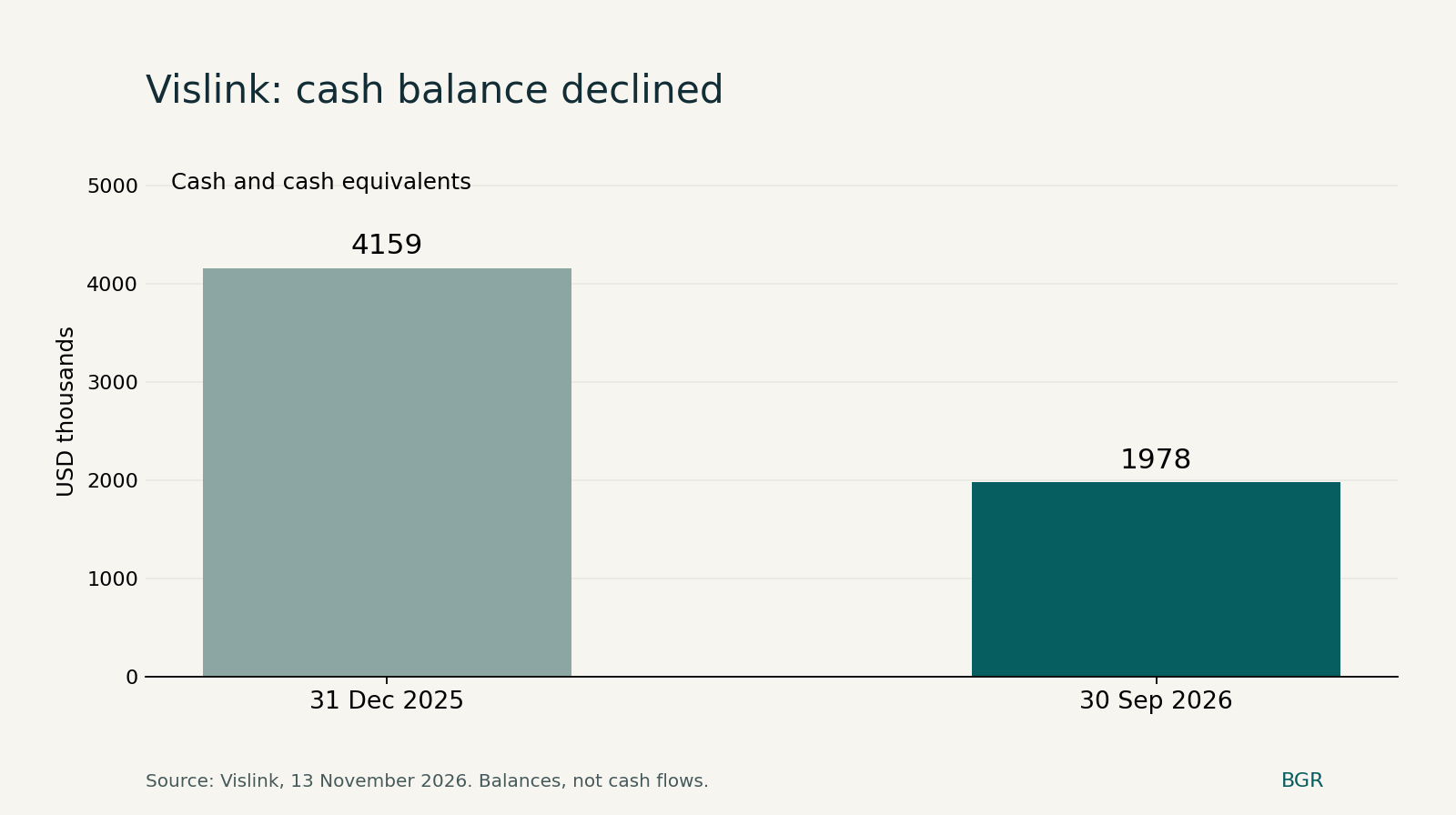
The second chart deliberately shows two cash balances and does not attempt to estimate a monthly cash-use rate from them. Such an estimate would require detailed examination of operating, investing and financing cash flows.
The distinction between profitability and solvency is practical: the timing of receipts from invoiced revenue, inventory funding and obligations falling due jointly shape available cash. We do not infer a particular overdue customer or financing problem at Vislink from this; these are channels that require separate examination in an analysis.
A conditional favourable scenario is that operating improvement is accompanied by a stabilisation in cash. A less favourable outcome would be narrowing losses while financial reserves continue to decline. We assign no probabilities to either path because the documents opened do not provide a sufficient basis for doing so.
Hungarian investors: currency, costs and execution
The return for an investor thinking in forints requires a calculation separate from the company’s accounts. In our own illustrative example, the investment value measured in US dollars rises by 10 percent while the US dollar’s forint value falls by 5 percent. The gross change in forints is then: 1.10 × 0.95 − 1 = 4.5 percent. This is an assumption, not an observed exchange rate or return forecast.
Reversing the currency movement, a 5 percent rise in the US dollar’s forint value would produce a gross forint return of 15.5 percent with the same investment-value change. The difference between the cases illustrates why currency risk cannot simply be ignored. Currency movements can also amplify losses.
Investor.gov’s international investing bulletin discusses currency conversion and transaction costs among the risk factors. For a Hungarian account, the actual fee schedule is the starting point: commission, the difference between buying and selling prices, conversion charges and account costs can affect the same transaction differently.
We do not estimate these costs using an invented provider fee. The gross example can only be turned into a net result using the actual account terms; the tax position requires separate examination. The currency perspective in our Bavarian Nordic analysis served the same separation, using another company’s figures.
The US investor-protection bulletin also warns that low market liquidity can make a security harder to sell. This is a general execution risk; without current trading-volume data, we do not state what selling quantity would move this stock’s price.
Our methodology starts with selected figures from the company tables opened, in thousands of US dollars, keeping the reference periods unchanged. The charts show the original figures; percentages are our own calculations, rounded to one decimal place. The company release is an issuer source, and the earlier report comes from the same company: these are not independent confirmations.
The charts use separate scales because quarterly performance and a balance at a reporting date are different concepts. A negative bar represents the loss in the first chart, while cash is a positive amount in the second. Compare the labelled values rather than visual distances; bar heights cannot be used to calculate a ratio across the charts.
In our interpretation, the next report would strengthen the case for a lasting improvement if a better result were accompanied by evidence that financial flexibility was being preserved. A management quote cannot substitute for that assessment. The dual test is useful because it separates the operation’s earnings capacity from cash available in the short term.
An investment decision would additionally require the stock’s actual valuation. We therefore offer no cheap-or-expensive judgement: shares in a company with improving results can still carry significant valuation risk. Reading the accounts provides a basis for examining that issue but does not replace the full decision process.
At the next earnings release, the joint development of revenue, operating results and cash will be the key verifiable development. The composition and timing of the change deserve separate attention. The current figures cannot settle that outcome in advance; this analysis provides no personalised recommendation to buy or sell.
Original editorial content. Read our editorial standards.
Budapest Global Review: Vislink: losses narrow while cash declines. Budapest Global Review, 13 November 2026. https://globalreview.hu/en/cikk/vislink-veszteseg-keszpenz-forint-2026