
ExxonMobil’s earnings announcement on 30 October presents different pictures of accounting profit and the company’s adjusted earnings. For Hungarian retail investors, the comparison matters because the same stock can produce different valuation ratios depending on which measure is chosen as the denominator.
Savers thinking in forints face an additional layer of currency exposure and costs. The calculations below reconcile the reported measures and then use a hypothetical example to show the sensitivity of returns in domestic currency. We use no current share price and make no personalised recommendation to buy or sell.
In brief
- The gap between adjusted and accounting earnings requires interpretation; it is not automatically additional cash.
- Free cash flow can be measured relative to operating cash flow, but that ratio is not a dividend promise.
- With the same US dollar return, movements in the forint and costs can produce different investor outcomes.
What do the two earnings figures measure?
ExxonMobil’s third-quarter release reports accounting earnings of USD 15.413 billion and adjusted earnings of USD 17.505 billion. Operating cash flow was USD 25.7 billion and free cash flow USD 19.1 billion. These are corporate reporting figures, not stock-market closing prices.
“Markets will change,” says chief executive Darren Woods. This short quotation comes from the release; the Hungarian version is our translation. We treat it as a management statement: it does not establish the direction of the share price or the durability of current profitability. Investors must distinguish the measurement bases even if they accept management’s longer-term argument.
Our calculation subtracts accounting earnings from adjusted earnings: 17.505 − 15.413 = USD 2.092 billion. Relative to accounting earnings, the gap is 2.092 / 15.413 × 100 = 13.57 percent, rounded to two decimal places. This measures the size of the difference; by itself it does not establish whether the company’s adjustments are justified or unjustified.
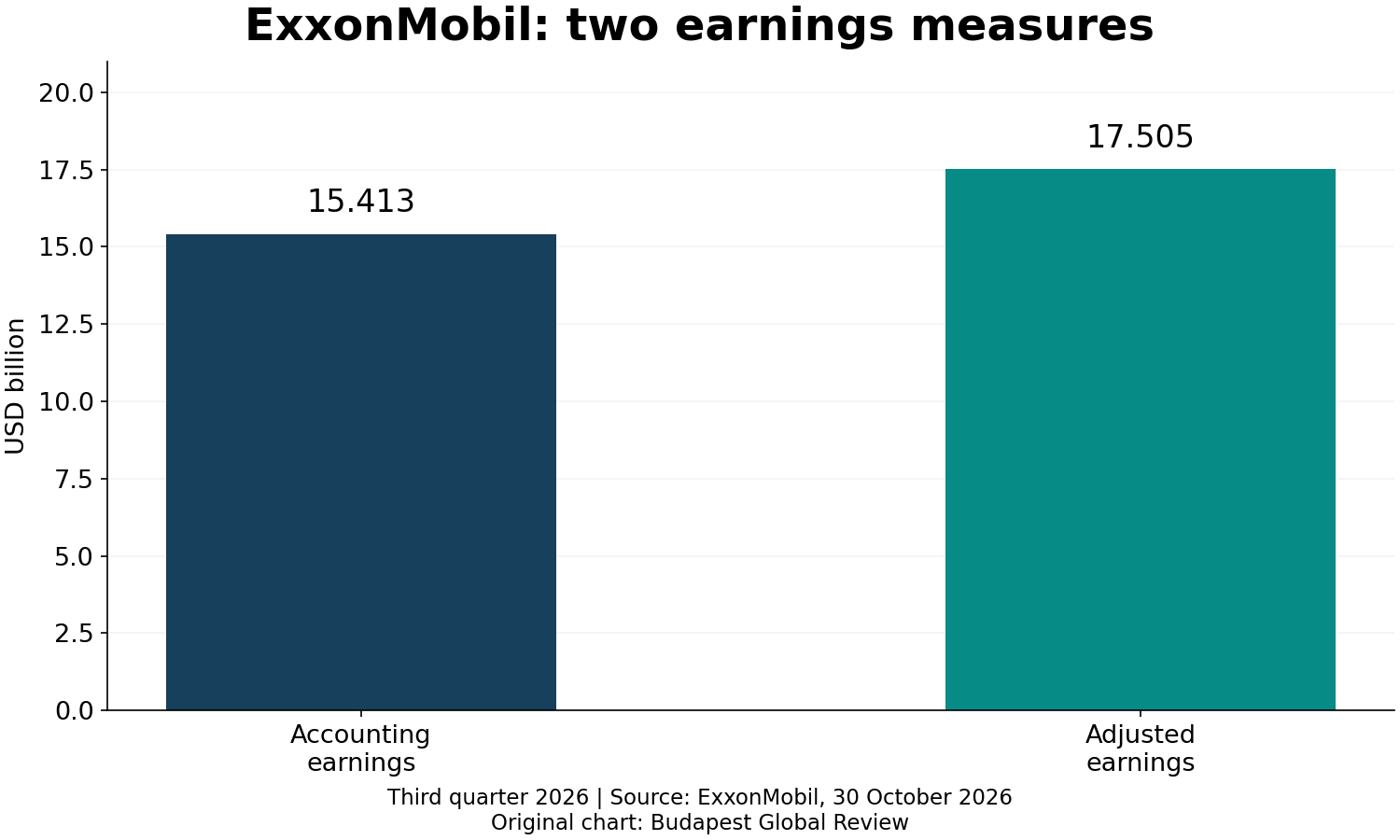
Original chart: two earnings measures for the same quarter, USD billion. Source: ExxonMobil, 30 October; the bars start at zero. The difference is not additional earnings to be added, but the distance between two measurement bases.
This matters for valuation because, with an unchanged equity value, higher earnings would produce a lower earnings-based multiple. Without a share price and share count, however, we do not calculate such a multiple here. First, investors must establish whether the adjustments made by the companies being compared are substantively equivalent and which items could recur. Regular recurrence of an item described as one-off can change the usefulness of the selected measure.
MarketWatch’s analysis of 30 October emphasises the role of refining margins in oil companies’ earnings. This is a separately edited interpretation, not a substitute for ExxonMobil’s accounts. Our inference is that the oil price alone may be too narrow an explanation for an integrated company’s total earnings; the effects of production, processing and other businesses merit separate examination.
Cash flow and financial flexibility
Our second calculation compares free cash flow with operating cash flow: 19.1 / 25.7 × 100 = 74.32 percent. The arithmetic difference between the two reported amounts is USD 6.6 billion. We do not automatically call this total capital expenditure, because that label requires separate examination of the company’s definition and reconciliation items.
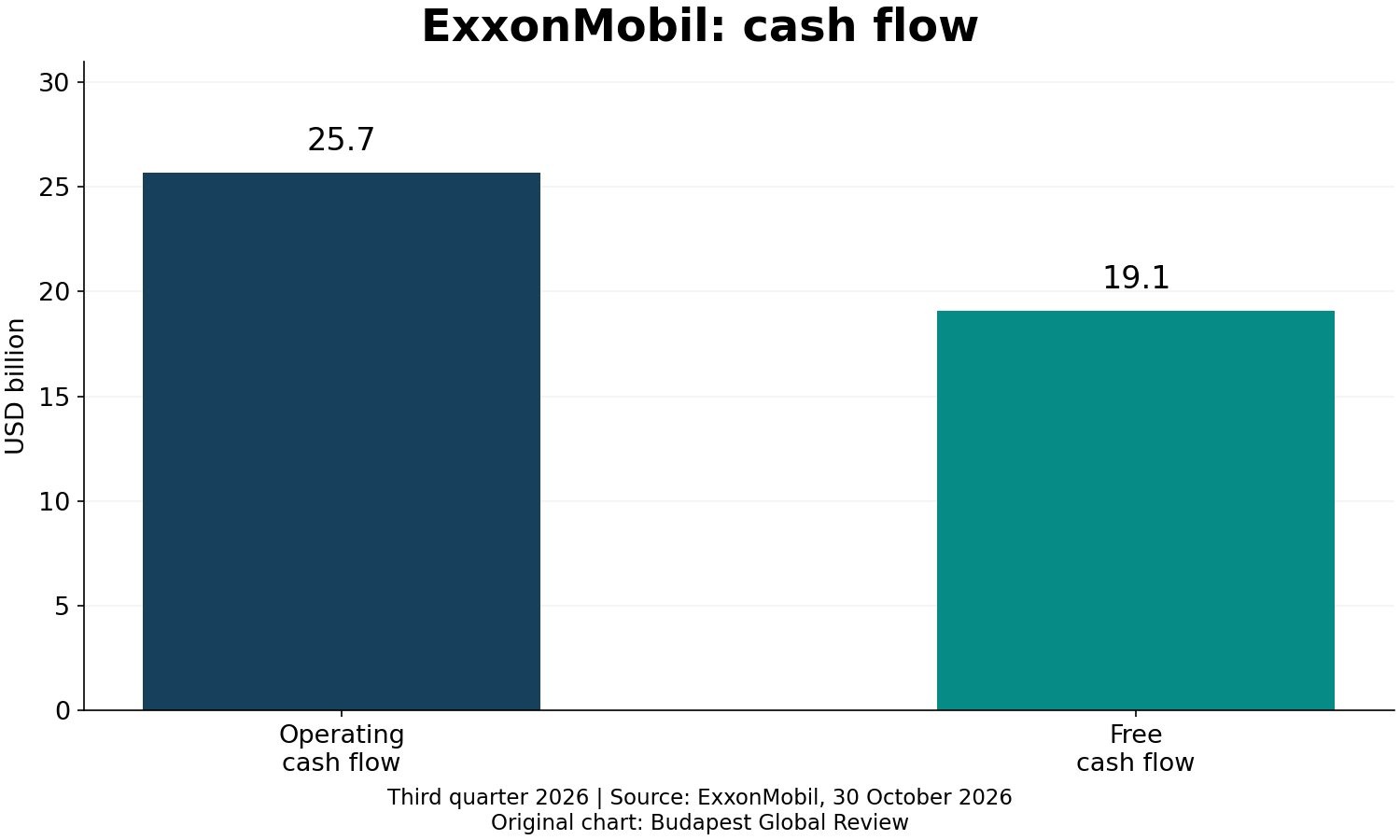
Original chart: operating and free cash flow in the same quarter, USD billion. Source: ExxonMobil, 30 October. Free cash flow is derived from the operating measure, so adding the two bars does not give the company’s total cash inflow.
A positive remainder may indicate financial flexibility, but its use involves separate decisions. Dividends, share repurchases, debt reduction and liquidity reserves affect shareholders differently. The timing of cash generation does not necessarily follow revenue recognition either. We therefore do not mechanically extrapolate one quarter’s ratio into the following year or treat it as a guaranteed distribution.
The method is reproducible: we select data for the same period and in the same currency, subtract and divide using the reported precision, and round only the final result. The charts answer different questions, so earnings and cash flow are not interchangeable. Any subsequent correction to the report would require the calculation inputs to be updated as well.
Our related Amazon analysis separates earnings from cash flow in a different corporate situation. The European refining dialogue provides sector background. Neither is a direct comparative valuation: measures from different business structures and periods are not ranked without separate reconciliation.
A forint scenario and the next check
In our hypothetical example, starting capital is 1,000,000 forints, the asset’s US dollar return is positive 6 percent, and the forint price of the US dollar falls by 4 percent. Total costs are modelled as a single 1 percent deduction. The final amount is 1,000,000 × 1.06 × 0.96 × 0.99 = 1,007,424 forints. These are assumptions, not observed exchange rates or provider fees.
If the forint price of the US dollar instead rises by 4 percent in the same model, the result is 1,000,000 × 1.06 × 1.04 × 0.99 = 1,091,376 forints. The difference between the final amounts is 83,952 forints. The assumed stock performance is unchanged; only the currency direction has been reversed. We apply percentages as multipliers rather than simply adding them.
The example excludes tax, dividends and interim cash movements. Actual account fees, currency-conversion spreads and tax treatment can differ; the relevant provider’s terms are needed for those. Currency hedging can introduce separate costs and contractual risks too. The model therefore illustrates sensitivity, not a complete investment account, and guarantees no particular transaction’s outcome.
The main forward-looking question is how far future reports sustain cash generation and how the distance between adjusted and accounting earnings changes. In a favourable scenario, operating inflows sustainably cover committed uses. In an adverse scenario, weaker margins, higher expenditure or unfavourable currency movements could reduce the shareholder’s forint return. These are analytical possibilities, not company forecasts.
The next calendar event verified in the release is the dividend record date of 16 November. This is not the same as a safe purchase deadline or the payment date; settlement and eligibility rules require separate checking. The next company report and its cash-flow reconciliation will matter for further earnings assessment; we give no unverified reporting date.
For tracking purposes, it is useful to retain the dates of source tables and the definitions of the measures. This separates subsequent changes from cases where only reporting methodology or the selected comparison period changes.
Original editorial content. Read our editorial standards.
Budapest Global Review: ExxonMobil: two earnings measures and the forint outcome. Budapest Global Review, 30 October 2026. https://globalreview.hu/en/cikk/exxonmobil-nyereseg-penzaramlas-forintkockazat-2026