
MNB Deputy Governor Péter Benő Banai discussed the stock-market role of household savings at the BÉT50 presentation, according to the central bank’s release of 16 November. For Hungarian retail investors, this raises two separate questions: how a company obtains financing, and what risk someone takes when buying shares.
The release refers to household financial wealth exceeding HUF 125 trillion in the second quarter and a 3.42% allocation to listed shares. It mentions approximately HUF 8 trillion in cash and HUF 18.4 trillion held in bank accounts without being tied up or earning a return. The release identifies “strengthening investor confidence” as important. These are institutional statements; they do not measure how much money might move into stocks.
In brief
- The full amount of liquid savings cannot be treated as money freely available for investment.
- Raising corporate capital and trading already issued shares involve different flows of money.
- Returns measured in forints depend on currency movements and costs as well as share prices.
From savings to corporate funding
The first chart places two reported balances side by side. Our addition gives HUF 26.4 trillion; cash represents a rounded 30.3% of that sum and money held in bank accounts 69.7%. The denominator consists exclusively of these two categories. These percentages therefore do not describe the distribution of all household wealth and cannot be compared directly with the share allocation.
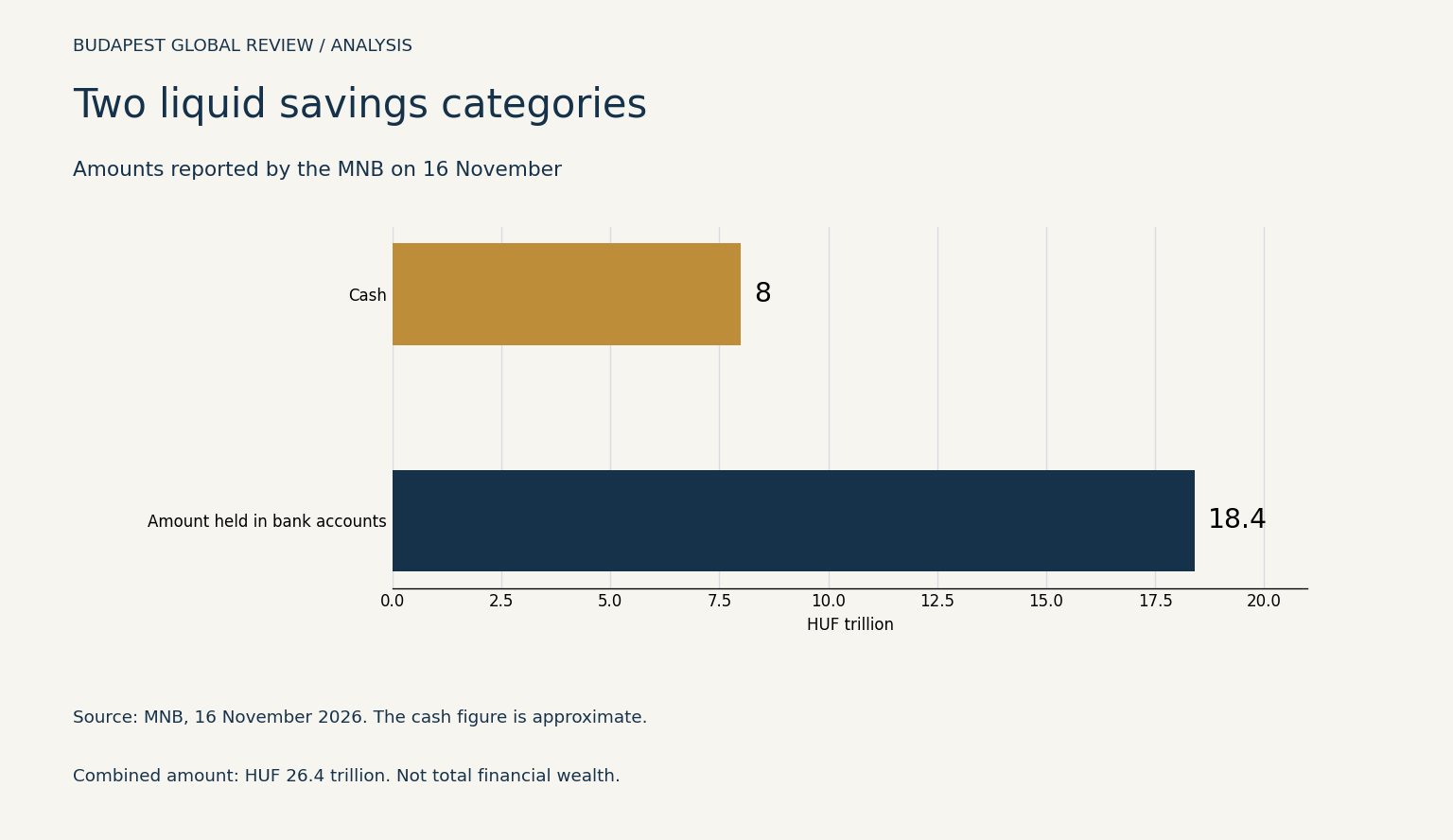
The calculation’s limitation has practical importance. A current account may contain next month’s rent, money reserved for tax payments or an imminent loan repayment. The statistical total does not distinguish these purposes. Our analytical conclusion is that estimating potential investor demand would also require knowing the savings horizon and restrictions on their use. Treating the entire sum as stock-market buying power would therefore overstate what the figures establish.
The US investor education guide describes a share as an ownership interest in a company; issuing shares can finance development, among other purposes. However, when someone buys an already issued share from another investor, the purchase price goes to the seller. The secondary market may facilitate subsequent sale, but describing every stock-market transaction as direct corporate fundraising would be inaccurate.
Assessing the financing story therefore requires establishing whether a transaction involves newly issued shares, a sale by existing owners, or a combination. Money used to build a production line has a different meaning from an owner reducing their holding. Both can be legitimate transactions, but the amount reaching the company and the opportunities for subsequent growth require separate examination.
What does the forint change?
The second chart is our own conditional calculation. It assumes starting capital of one million forints, a 10% rise in a foreign share price and two different currency paths. If the foreign currency’s price in forints falls by 5%, the gross forint return is 4.5%; if it rises by the same amount, the return is 15.5%. These are assumptions, not current exchange rates or forecasts.
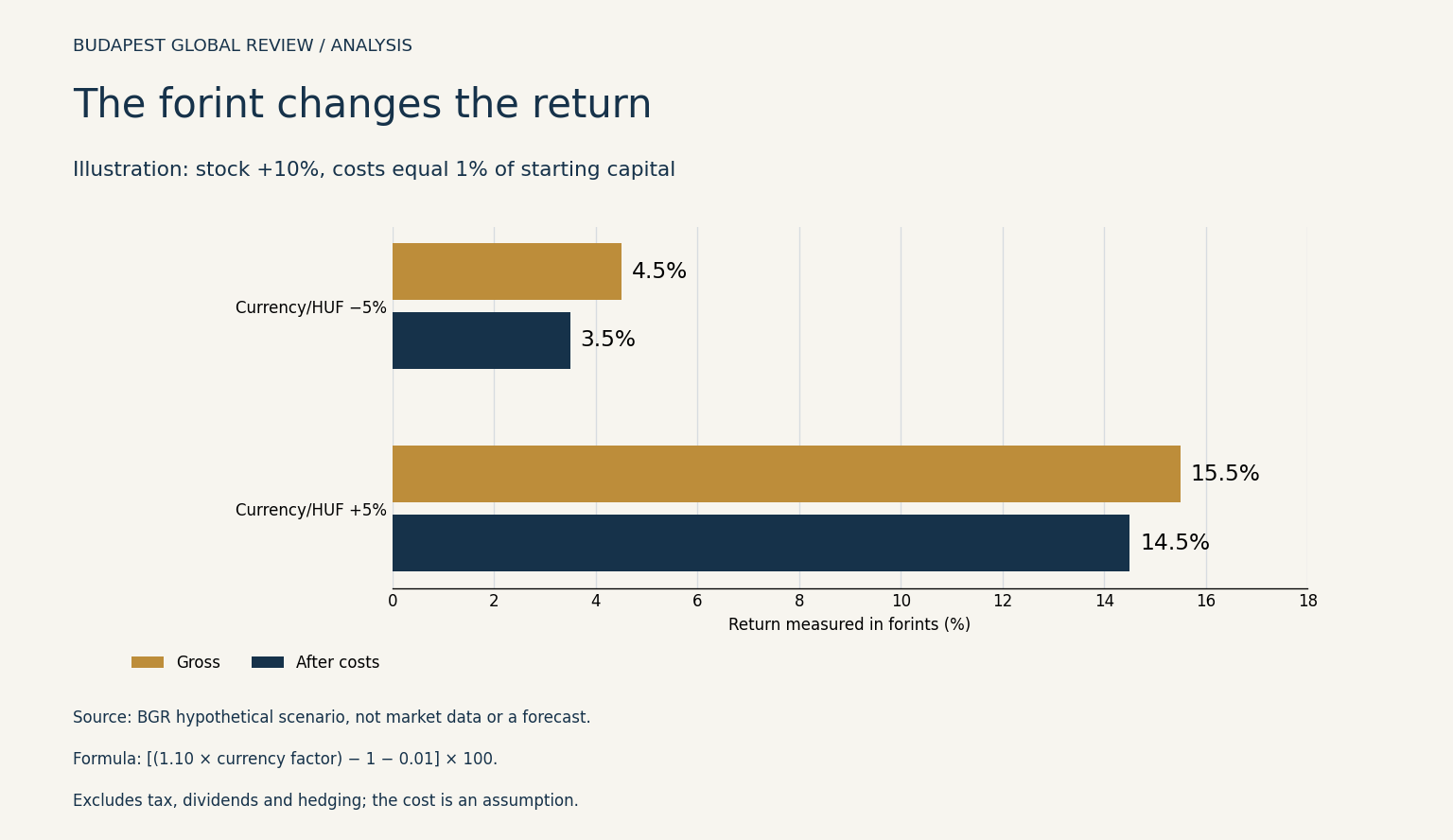
The method uses multiplication: the share’s value factor of 1.10 is multiplied by 0.95 or 1.05. We subtract the starting unit from the result. In this example, total costs equal 1% of the original capital, or ten thousand forints. We deduct this fixed amount, rather than a percentage of the final portfolio value. Returns after costs are therefore 3.5% and 14.5%, leaving closing wealth of 1035000 and 1145000 forints respectively.
The cost assumption is not a provider’s quotation. We exclude tax, dividends and hedging and do not attach the period to any specific investment. The reproducible formula is starting capital multiplied by the share factor and currency factor, less costs calculated on starting capital. For an actual account, each fee must be applied to its own charging base, because a minimum charge or a currency conversion spread can behave differently.
The loss-making version matters just as much. If the share falls by 10%, the same two currency paths produce gross losses of 14.5% and 5.5%. After deducting the assumed cost, the losses become 15.5% and 6.5%. A favourable currency movement can therefore cushion a share-price decline, but does not turn it into a profit in this example. Because multiplication is involved, the combined effect of symmetrical share-price changes is not simple addition.
Investor.gov’s international investing guide addresses currency movements and additional costs separately. For Hungarian readers, the implication is that a foreign share’s performance in its own currency is only one input. The difference between expenditure payable in forints and an asset recorded in foreign currency should be made visible on a separate line.
Outlook and verifiable conditions
In the favourable scenario, savings available over a longer horizon meet transparent corporate financing opportunities. This requires an understandable business model, traceable use of proceeds and regular reporting. In the adverse scenario, the investor needs cash soon while prices fall or selling becomes harder. The household’s financial reserve can also make a difference between these situations.
A company’s latest earnings are likewise insufficient in isolation. Earnings quality, cash generation and the price paid by the investor together determine the questions that valuation must address. Our analysis of OTP’s two profit measures examines comparability, while the latest housing loan stock figures show the other side of household balance sheets. Neither supports a general recommendation to buy shares.
The charts deliberately separate two methodological levels. The first uses amounts from an institutional release and our own ratios; the second uses exclusively hypothetical returns. We do not derive the probability of the second from the first. Ratios are rounded to one decimal place; intermediate results in the currency example were calculated without rounding. The approximate nature of the cash figure also carries over into the combined amount.
Distribution matters alongside the national average. The same financial wealth can conceal very different investment capacity depending on whether it is concentrated among a few households or spread across many families. We do not establish this from the balances in the release. We therefore assess macroeconomic potential separately from individual capacity: high national savings alone do not show how much temporary loss a particular family could absorb without jeopardising its expenditure.
The next meaningful verification point could be the documentation for a specific share issue or a company’s new report: how much money reaches the business, how it will be spent, and how shareholders’ exposure changes. The central bank’s present statement provides a framework for that examination, but cannot replace individual documents. Our analysis offers decision criteria and a calculation method, without personalised advice to buy or sell.
Original editorial content. Read our editorial standards.
Budapest Global Review: Savings in stocks: where forint risk begins. Budapest Global Review, 16 November 2026. https://globalreview.hu/en/cikk/lakossagi-megtakaritas-tozsde-forint-kockazat-2026