
The central bank base rate remains 5.50 percent from 18 November following the MNB’s decision the previous day. For a Hungarian retail investor, that does not guarantee an unchanged selling price for an existing fixed-rate bond: the price depends on both the remaining cash flows and the return required by the market.
The central bank’s statement of 17 November says “maintaining interest rate conditions is necessary” (our translation). Portfolio’s report that day also recorded the unchanged base rate. Our calculations below illustrate interest-rate risk using hypothetical bonds; none of the figures is an actual offer to buy or an observed market price.
In brief
- A fixed coupon determines the payment, not the selling price before maturity.
- With the same coupon, a longer maturity can mean greater sensitivity to yields.
- Costs and currencies can separately alter an investor’s actual outcome.
Prices can move despite an unchanged policy rate
The central bank base rate and a particular bond’s market yield are different concepts. The former is a monetary policy instrument; the latter expresses the return buyers require for a given cash flow. A bond’s price can therefore change while the base rate stays still: expectations about future interest rates or risks relating to the issuer may change, for example. We are not asserting that such a movement occurred in today’s market.
Investor.gov’s guide to bonds highlights the downward price effect of rising interest rates and the risk of issuer default. These risks require separate assessment: a fixed payment promise offers little protection if the borrower fails to pay, while even a solvent issuer’s bond may fetch a less favourable price when the yield environment changes.
For Hungarian savers, when the money will be needed is a practical consideration. Ahead of a planned housing expense or business contribution, the relevant question is how much cash will be available on the required day. Face value, the valuation shown on an account and actual sale proceeds therefore belong on separate lines in a useful comparison.
Our related analysis of savings and forint risk examines the issue from another asset class. The present model focuses exclusively on simple fixed-coupon bond pricing, so we draw no numerical conclusions from it about equities or floating-rate products.
Our calculation: the same coupon, different maturities
The model has a face value of 100 units and an annual coupon of 5.50 units. The calculation starts immediately after a coupon payment; identical annual payments follow, with face value repaid at maturity. There is no accrued interest, tax, default, early redemption or embedded option. These are assumptions, not the terms of an available investment. We chose a coupon matching the base rate for illustration; the central bank does not promise that bond yield.
The formula adds the present value of principal at maturity to the discounted sum of the remaining annual coupons: P = Σ C/(1+y)^t + N/(1+y)^n. Here C denotes the coupon, N face value, y the annual required yield, n remaining years and t the year of each payment. The model applies the same yield at every maturity and thus assumes a flat yield curve.
With two years remaining and a required yield of 4.50 percent, the price is 101.87 units. At the initial 5.50 percent yield it is 100.00, while at 6.50 percent it is 98.18 units. For a ten-year maturity, the corresponding prices are 107.91, 100.00 and 92.81 units. Calculations used full precision; rounding was applied only for display.
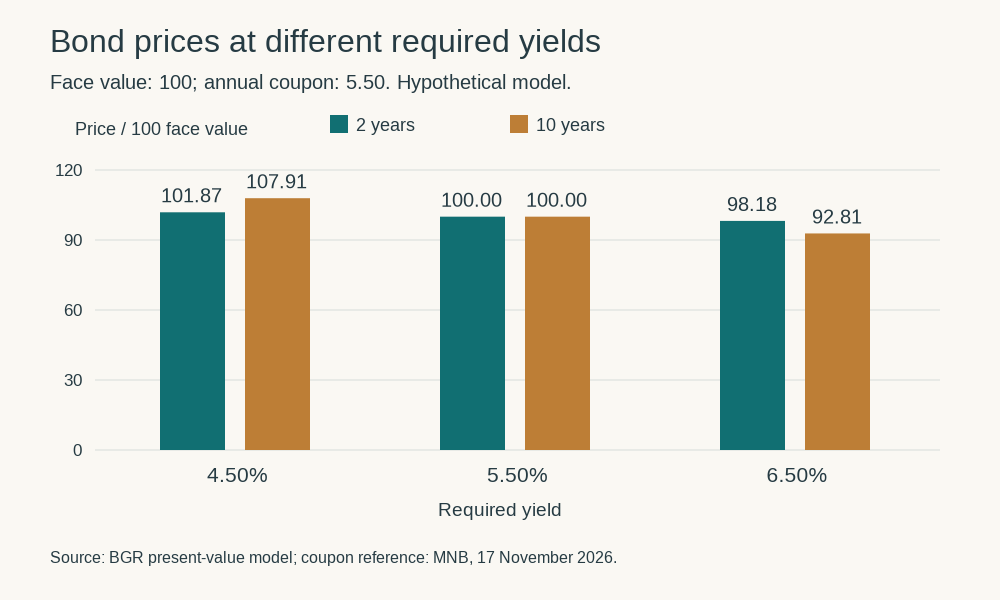
The first chart shows these prices, not actual bond quotations. Its source is our present-value model; the numerical starting point for the coupon is the MNB statement. In the second chart the required yield rises uniformly from 5.50 percent to 6.50 percent. The immediate price loss is 0.94 percent for one year, 1.82 for two years, 4.16 for five years and 7.19 for ten years.
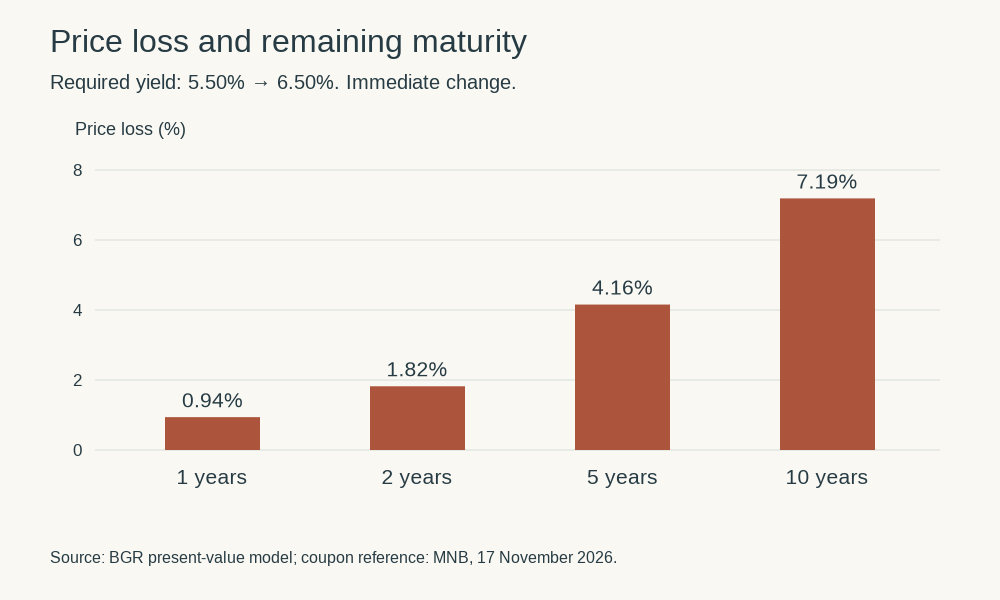
The second chart is also our calculation, using the same formula and assumptions. The difference arises because the present value of more distant payments is more sensitive to the discount rate. This conclusion applies to the compared examples: different coupons, options, credit risks or yield curves can produce different sensitivities.
Costs, currencies and the next decision point
The price movement should not be read as a full year’s investment return. In this example, the required yield jumps instantly; no time passes and no coupon is paid. A real holding-period result must also account for payments received, their reinvestment and the timing of the sale.
If the ten-year example is sold immediately after the price movement and total costs equal 1 percent of the initial face value, the result is minus 8.19 percent. This is a separate cost assumption, not a provider’s fee. The difference between bid and ask prices, account charges and taxation can be additional product-specific factors in a real transaction.
A forint-denominated bond has no direct currency-conversion effect for an investor measuring wealth in forints. With a foreign-currency bond, exchange-rate changes add another layer to the bond outcome. If its foreign-currency value stayed unchanged, an assumed 5 percent appreciation of that currency would produce the same rise in forint value before costs; depreciation would reverse the direction. This is a scenario, not an exchange-rate forecast.
Holding to maturity can reduce the significance of interim price movements, but payment, inflation and reinvestment risks still need examination. A bond fund’s portfolio can change continuously, so the maturity logic of a single security cannot be applied unchanged to the whole fund.
Three conditional directions frame the outlook: falling required yields raise model prices, rising yields lower them, and with unchanged yields the passage of time and cash flows become decisive. We assign no probabilities to these directions. The next official information is the abridged minutes of the MNB’s November meeting, due on 2 December at 14 hours.
Comparisons should place offers at the same point in time and in the same currency. A higher coupon need not deliver a higher return if the buyer pays more for it. Choosing a longer maturity also determines how long the money is tied to contractual payments, alongside price sensitivity. The model’s value is that these effects can be varied separately while the other assumptions remain fixed. This helps comparison.
A decision requires the specific security’s documentation and its current selling price. Our earlier inflation analysis adds the purchasing-power perspective. This is a general risk analysis without personalised recommendations to buy or sell.
Original editorial content. Read our editorial standards.
Budapest Global Review: Unchanged base rate, different bond risks. Budapest Global Review, 17 November 2026. https://globalreview.hu/en/cikk/mnb-kamattartas-fix-kotveny-arfolyamkockazat-2026